❌

普通视图

  • ✇Chris Dillow
  • The party of business? Chris Dillow
    Will Davies asks a good question: why is there no longer a successful party of business?He’s got a point. The Tories are still struggling to win the support for more than one-fifth of voters, whilst Reform’s appeal is more to pensioners and racists than to business. As James Orr confessed to Channel 4: “We just don’t have British resident donors - British entities - that would support us” (10’34” in.)Why don’t they?Will gives one good reason; the
     

The party of business?

2026年11月18日 17:16

Will Davies asks a good question: why is there no longer a successful party of business?

He’s got a point. The Tories are still struggling to win the support for more than one-fifth of voters, whilst Reform’s appeal is more to pensioners and racists than to business. As James Orr confessed to Channel 4: “We just don’t have British resident donors - British entities - that would support us” (10’34” in.)

Why don’t they?

Will gives one good reason; the right has no clear sense of who the baddies are. Thatcher could build a plausible economic narrative by demonising trades unions and nationalized industries. The right today, however, cannot do so. Its outgroups are benefit recipients and immigrants. You can’t spin a serious economic story around these, in part because it would contradict itself: “too few of those people are applying for jobs, but too many of them.”

Worse still, any plausible economic narrative from any sort of free-market perspective would need to identify baddies who are traditionally right-wing voters: rural nimbys who oppose new building; inept managers who are holding back productivity; lawyers and accountants who benefit from a complicated tax system; those working in our bloated financial sector; and bosses of monopolistic companies.

In a rational political culture, this wouldn’t much matter because we wouldn’t attack outgroups at all but instead would discuss the economy as a system. But of course, ours is not a rational political culture. It needs outgroups, and the only ones acceptable to the right preclude it being a party of sensible economics.

But there’s another reason why the right find it difficult to be coherently pro-capitalist in the sense that Thatcher could be. It’s because there are conflicts of interest between capitalists. Some want a highly-skilled workforce which requires a thriving university sector; others can make do with unskilled staff. Retailers need low rents; landlords want high ones. Exporters and some importers want us to be in the EU single market, but hobbyist hedge fund managers and newspaper owners don’t. Tourist industries want clean water and a pleasant environment; water companies and high-volume builders do not. Retailers want a mass market in which aggregate demand is running hot, but financiers prefer the low real interest rates which weak demand brings. Large incumbent companies want protective regulation; start-ups want more competitive conditions. And so on.
Granted, there are a few common interests among all these conflicting ones: low and simple taxes; the rule of law; economic stability; and so on. But these are precisely what the right has been unable to supply. It’s given us a more complicated tax system; years of uncertainty over Brexit and migration policy; support for a US president who has imposed tariffs and high oil prices; and sympathy for fascist rioters. All of this is more anti-capitalist than anything the left is offering now*.

In this context, the right’s interest in deregulation is wholly understandable: it’s the only card they have to play.

But it’s a low no-trump. For one thing, the politics of deregulation are tricky. Everyone likes it in the abstract, but not in the particular - if it means a solar farm next door, shoddy and ugly buildings, or competition for our business. What US senator Russell Long allegedly said of taxes also applies to regulation:

Don’t tax you, Don’t tax me, Tax that fellow behind the tree.

Also, successful deregulation requires particular conditions, one of which is that there be a degree of equality of bargaining power (which includes more equality of information). The right, however, has no interest in creating such conditions, not least because doing so would undermine the interests of extractive capital: rip-off fund managers; overcharging utilities; landlords; and so on.

And even if we did get deregulation, it might not stimulate the economy. It’s very possible that our long-term stagnation is because capitalism has simply run out of dynamism, rather than because of meddling by those pesky kids.

The right cannot therefore articulate meaningful pro-capitalist policies. The limiting of its appeal to pensioners and bigots is no accident: it has no alternative.

The only sense in which the Tories or Reform are pro-capitalist is that they deflect attention from the failures of capitalism by shifting the blame for our economic problems onto migrants or benefit recipients - but then the same could be said of Labour.

Which poses the question: what, then, might a reasonable party of capitalists look like? It would be most odd not to have one, given that almost our entire political spectrum is pro-capitalist.

There’s room for a quite progressive party. It would want us to rejoin the EU, prioritizing the interests of exporters over the obsession of a few cranks. It would want a liberal immigration policy not because immigrants cut wages (they don’t) but because they can fill labour market shortages. It would want a simpler tax system, especially one that’s easier for the self-employed and which removes the high tax rates for parents earning just over £100,000. It would want to tax land rather than incomes. It would support universities as providers of technology, skilled workers and good jobs around the country. It would foster consumer advice and advocacy groups to ensure that good value financial products, phone and broadband contracts win customers, thereby helping efficient companies. And it would intervene in energy markets to ensure that UK companies no longer pay the highest electricity prices in Europe, which would include big building of solar and wind generation.

A progressive pro-capitalist party is therefore easy to imagine. It isn’t very far from the LibDems, although they carry the obnoxious baggage of the 2010-15 government.

I don’t know if such a programme could succeed. If it can’t, then the inference is obvious - that UK capitalism can now offer only reaction and stagnation.

* A wealth tax is not enough to make you anti-capitalist.

Discussion about this post

Ready for more?

  • ✇Chris Dillow
  • On ambiguity Chris Dillow
    The debate about AI highlights a paradox - that our attitudes to ambiguity or uncertainty* are, well, ambiguous.I’m prompted to say this by a great essay from Will Davies. He describes how, long before the use of AI, literacy became an exercise in decoding and pattern recognition, which are “precisely the techniques that machines can execute on a larger scale and at greater speed than human brains.” What this approach leaves out is the centrality of ambiguity. Great writing o
     

On ambiguity

2026年10月30日 17:42

The debate about AI highlights a paradox - that our attitudes to ambiguity or uncertainty* are, well, ambiguous.

I’m prompted to say this by a great essay from Will Davies. He describes how, long before the use of AI, literacy became an exercise in decoding and pattern recognition, which are “precisely the techniques that machines can execute on a larger scale and at greater speed than human brains.”

What this approach leaves out is the centrality of ambiguity. Great writing often has multiple, conflicting meanings leaving us uncertain about what the author meant. And a great work is not merely a tool we use for our own predetermined purposes but something that changes us in ways we can’t foresee - which is yet another form of uncertainty. Ambiguity/uncertainty is at the centre of reading and writing; it’s no accident that one of the great works of literary criticism was called Seven Types of Ambiguity.

Those who think that AI can replace humans in reading and writing deny the centrality of such ambiguity, wanting to reduce reading to decoding and machine learning. But these same people who dislike ambiguity in literature are often those most likely to be AI boosters, wanting to embrace the uncertainties surrounding how AI might change our working lives and society.

And vice versa. Those who stress the value of ambiguity in literature can be those most averse to the ambiguities and uncertainties involved in widespread adoption of AI.

All this seems like a paradox.

And it is, from the standpoint of conventional economics. Inspired by Frank Knight’s 1921 book, Risk, Uncertainty and Profit, economists have long distinguished between risk (known probabilities) and uncertainty, where probabilities are not known**. The distinction matters because in 1961 Daniel Ellsberg showed (pdf) (based on a straw poll of his friends) that people would rather bet on risk than uncertainty; they’d rather bet on drawing a ball from a bag with known proportions of different coloured balls than from one with unknown ones. Since then, we’ve thought that ambiguity aversion was different from risk aversion.

Ellsberg’s finding has been challenged. Daniel Chen and Martin Shonger say that what looks like ambiguity aversion in Ellsberg’s work is in fact an aversion to asymmetric information; the guy putting balls into the bag knows the odds, and we don’t want to bet when we know less than our counterparty.

The plausibility of this objection, however, runs into a problem; there is one context where people have for years been keen to trade when they’re at an information disadvantage - on newly floated companies. Sellers of these know more than buyers and use this advantage to sell at the right time; Jay Ritter has shown that such shares underperform (pdf) the market in the first three years after flotation. And yet investors pile in despite this - as the performance of SpaceX since flotation reminds us.

Evidence that people hate uncertainty isn’t, however, confined to academic experiments. It also comes from real-world behaviour.

For one thing, many people have for years under-invested in equities with the result that these have been (or were!) under-priced, thus offering better returns than their measurable risks would warrant. One explanation for this (of many!) is that equities are an uncertain prospect, and people avoid uncertainty. Yes, we can quantify the past distribution of equity returns but we cannot be sure that the past is an adequate description of the future; if you think it is, you’re well qualified to be a bank’s risk manager, but less qualified to manage your own money.

More evidence of ambiguity aversion is that crises are so traumatic. They are because they are uncertain times, in the specific sense that they see (to use the title of Richard Bookstaber’s book) the end of theory. Things we used to rely upon - easy credit, liquid markets, historic distributions of returns - become unreliable. That’s uncertainty, and it’s unsettling.

And then there’s inflation. People hate this by more than its quite modest observable costs would imply. One reason for this is that inflation creates uncertainty; how high will it go? How long will it last? What will things cost in a few months’ time? It’s this we dislike. As inflation rose in the 70s, so too did households’ savings. That makes little sense when you consider that inflation erodes the value of money, but a lot of sense if you consider high savings to be an instinctive response to uncertainty.

This aversion to uncertainty arises from reasonable sources.

It can be associated with catastrophic risk - of bankruptcy or of equities becoming worthless: Russian equities looked like a good but risky bet in 1916, but proved a catastrophic one a few months later. The claim that AI could have disastrous effects is unsettling because it is an uncertain one; we’ve insufficient evidence to assess it.

And for another, there are contexts in which we really should avoid uncertainty. “Will this bridge hold up under stress?” or “can we trust the auto-pilot?” are not questions where we want an ambiguous answer. The purpose of many engineering occupations especially is to eliminate uncertainty. And professional deformation means that it’s easy to transfer this laudable aim into contexts where it might not be so appropriate.

Our hatred of uncertainty explains why the most important places in the US are Hollywood, Motown and Nashville. The film, TV and music industries have for decades done something incredibly important. They’ve given non-Americans the impression of familiarity with the country, thereby reducing the uncertainty of investing in what is in fact a deeply weird place. The result is that the US benefits from what Valéry Giscard d’Estaing called “exorbitant privilege” - the ability to borrow more cheaply than the country’s objective facts (such as political instability and big deficits) would warrant.

But, but, but. Whilst some of us avoid uncertainty, others chase it. In recent years, they’ve bet on uncertainties as various as cryptocurrencies, AI stocks, meme stocks, initial coin offerings and non-fungible tokens, with wildly varying results.

Which isn’t entirely daft. Although uncertainty can entail an unknowable chance of disaster it can also entail a chance of huge upside, a modest ungeared bet on which can be reasonable. This is especially true because uncertainty sometimes helps us learn. New drugs, for example, are uncertain prospects. But venture capitalists are happy to bet on them because they often have the chance to either cash out or invest more at the end of particular phases of the trial, and even if they lose they might well have gained some useful knowledge that’ll help in other investments.

It seems, then, that our attitudes to uncertainty are all over the place; some of us love it, some hate it, and some love it in some contexts and hate it in others.

There might be a reason for this. Craig Fox and Gülden Ülkümen distinguish between two types of uncertainty. One is aleatory. This is when outcomes can differ each time one runs an experiment under similar conditions. The other is epistemic. This is when something is either true or not, but you don’t know which.

Which is the bigger city: Dortmund or Leipzig? That’s a matter of epistemic uncertainty: one is bigger, but you’re not sure which. Will Borussia Dortmund beat RB Leipzig this season? That’s aleatoric uncertainty; even if you’re confident that Dortmund are generally the better team, you can’t be confident they’ll win on the day.

And we’d often rather bet on aleatoric than epistemic uncertainty. If we lose a bet on the latter, it’s a personal failing; we just didn’t know enough. Losing on the former, however, is much easier to justify; if a stock falls, it’s because the management was bad or the Fed was wrong to raise rates, just as if a football team loses it’s because the players let us down.

This might help explain why some fans of AI are so loath to accept ambiguity in human communication. They think of their equity investments as aleatoric uncertainty but see an ambiguous text as a source of epistemic uncertainty. If the latter threatens your self-image as a smart guy, you’ll be especially keen to avoid it. Others, however, are more comfortable with epistemic uncertainty. An education in the classics, history or literature leaves people more comfortable with knowing that some things are unknowable and hence more tolerant of epistemic uncertainty whilst having no effect on their attitude to aleatoric uncertainty.

The bottom line here is that our attitudes to ambiguity and uncertainty differ not just from person to person but from context to context.

Which is also true of our attitudes to risk. Some people engage in risky sports such as rock-climbing but avoid risky investments, and others do the opposite. Michael Woodford has helped explain why (pdf) it’s because we code different probabilities in a different way. In thinking about our house we consider the small but nasty chance of a fire. In thinking about equities, however, we might consider losses as a temporary and less psychologically intrusive problem. These aren’t just differences in magnitude, but in type, with the result that we buy insurance and take investment risk at the same time - something which conventional thinking about risk has for years struggled to explain.

All this should trouble only those people who want to reduce preferences to simple coefficients, and who want to deny the crooked timber of humanity in favour of simple mathematical models. The trouble is, the world isn’t like that.

* Throughout, I’ll be using the two words interchangeably. If you don’t like this ambiguity, consider yourself to be another datapoint in my story.

** Merely attaching a number to one’s uncertainty (”there’s a 25.7% chance of a recession next year”) does not resolve this distinction, and only the lower-grade of investment analyst thinks it does.

Discussion about this post

Ready for more?

  • ✇Chris Dillow
  • On legacy ideas Chris Dillow
    A lot has been written about how the right has been radicalised in recent years. Among civilised people, however, there is the opposite problem - that their beliefs have not sufficiently changed with the times.Napoleon never actually said “to understand the man you have to know what was happening in the world when he was twenty”, but if he had he would have been right. Our formative years are, well, formative. People who grew up in hard times (pdf) are more risk-averse in later life
     

On legacy ideas

2026年10月20日 16:13

A lot has been written about how the right has been radicalised in recent years. Among civilised people, however, there is the opposite problem - that their beliefs have not sufficiently changed with the times.

Napoleon never actually said “to understand the man you have to know what was happening in the world when he was twenty”, but if he had he would have been right. Our formative years are, well, formative. People who grew up in hard times (pdf) are more risk-averse in later life and even more introverted and emotionally unstable. It’s plausible therefore that ideas we acquire in our formative years might persist decades later, even outliving their empirical base.

One example of what I mean is Labour’s desire to create good jobs. This is wholly understandable; anyone over the age of 40 would have been formed by experience of mass unemployment, when job creation should have been the top priority. But things aren’t so simple today. We’re not far from what is effectively full employment; there’ll always be some jobless because of mismatches between the characteristics of the unemployed and those required by employers. In this world, significant job creation would lead to higher wage inflation, to which the Bank of England would respond with higher interest rates. (The same of course would be true of significant increases in military spending.)

For now, at least, therefore, our problem isn’t simply to create good jobs. It’s to destroy some others to make room for the ones we want: builders, solar panel makers, heat pump installers, drone manufacturers, carers and so on.

You might imagine that this is the function of macroeconomic policy; higher taxes or higher interest rates do indeed destroy jobs.

Problem is, they’re not necessarily the ones we want to destroy. Such measures would tend to depress consumer spending and hence risk exacerbating the decline of our high streets. Not only is this a bad thing in itself, it would tend to strengthen the far right.

Here we run into another idea from our youths that is no longer useful. Maynard Keynes wrote:

I see no reason to suppose that the existing system seriously misemploys the factors of production which are in use...It is in determining the volume, not the direction, of actual employment that the existing system has broken down.

This, however, is no longer true. Factors of production are misemployed. We have “genuinely unskilled” fund managers exploiting clients; young Deliveroo riders jeopardising pedestrians; bullshit jobs; surveillance and guard labour; and well-paid lawyers and accountants helping people dodge tax. Higher taxes or interest rates on their own won’t destroy these jobs. We need other, more interventionist, policies. But decades of that Keynesian mindset don’t prepare us for thinking about these.

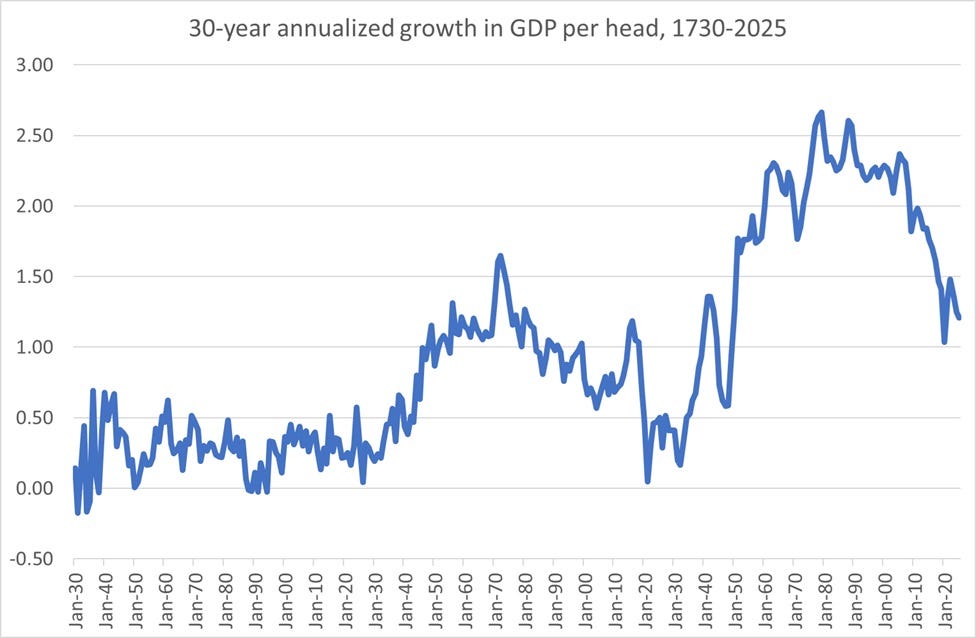
This is not the only way in which faith in free markets is a legacy idea that’s no longer so relevant today. Most of us over the age of 40 were educated to take decent economic growth for granted; in the 60 years after WWII real GDP grew by an average of 2.3% a year.

Such dynamism led politicians to believe that the task of government was mostly to create the conditions in which capitalism could get on with the job of delivering the goods. On the Tory side, these comprised weaker trades unions, privatization, tax cuts and government otherwise stepping aside; on the Labour side policy stability and education. Both, though, took for granted an underlying dynamism. But that has disappeared, and might in fact have been only an artefact of the post-war years. Our challenge now is either to find new ways of raising growth (which requires an attack on powerful vested interests) or to find ways of living with stagnation. The political elites seem unable to do either.

Yet another outdated legacy idea is our attitude to markets. Those of us formed during the cold war and its aftermath were inculcated into a simple ideological dichotomy: free markets vs central planning. The upshot is that we’re ill-equipped to think of the market as a technology - something that’s more useful in some contexts than others, and which needs adapting to conditions.

Ronald Coase famously pointed out that there is “a cost of using the price mechanism”. This can be the cognitive load of finding the best products or jobs; the difficulty of minimizing how much one is ripped off by utility and broadband suppliers; time spent shopping around; the difficulty of enforcing or escaping contracts; and so on. Companies have evolved ways of reducing this cost. For individuals, however, this evolution has been less developed. We know that state regulation is inadequate, but could we not develop stronger consumer advisors and advocates to both help us in markets and be a countervailing power to that of big companies? Again, the legacy of an ideologized state vs market dichotomy holds us back from more rigorous thinking that can address the problems of rip-off Britain.

There’s another damaging legacy idea: our attitudes to the media. Years ago, millions of people bought newspapers: in 1992, for example, the combined sales of the Sun, Mail, Express and Telegraph were 7.8m a day. That meant governments had to pay attention to the newspapers not only because they reached so many voters but also because they expressed the opinion of those voters. Today, however, these four sell only around 1.5m (we can’t be exact because the Telegraph and Sun no longer publicise their sales). That represents less than one voter in 30, and I suspect many of these buyers are fixed in their voting intentions.

During my adulthood, the press has gone from mainstream to marginal. And yet it still dominates politics not merely because MPs court its favour but because it sets the agenda, even on the BBC. The upshot is that politics is dominated by culture war BS and attacks on migrants, trans people and scroungers to the detriment of issues that affect our everyday lives such as stagnating living standards, rip-off utility bills, high street decline, climate change, poor public services and so on.

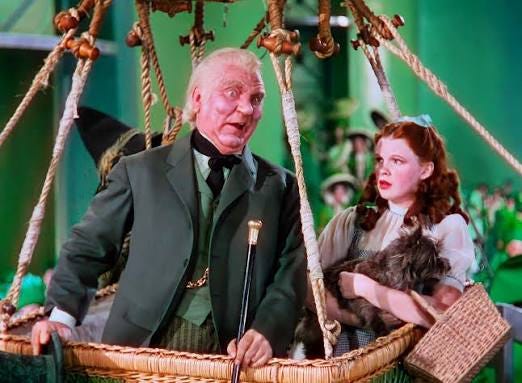
This dominance, however, is a legacy idea. It was formed when the press was influential and persists beyond its evidence base. But the fact is that newspapers represent a small, cranky and racist minority; many more people today own a fishing licence than buy the Daily Mail on a typical day. Their power is like that of the Wizard of Oz’s; it exists only because people believe in it, and behind the curtain is a mere humbug.

Recognizing that our ideas about the media are out-dated is, however, only part of the story. The questions then arise: is it possible to rebuild our public sphere so as to permit rational informed debate? Can we overcome the problems posed by fragmentation, cranks and fanatics? Again, old ideas are no use to us.

I don’t intend all this as a complete list of zombie ideas; I’d add the idea of bankers’ bonuses to that. I do so merely to show that the ideas that people over the age of around 50 formed in their youth are a handicap to thinking about politics today. Modernization has a bad rap these days, partly because it is tainted by association with Blairism, but it is just what we need now.

Discussion about this post

Ready for more?

  • ✇Chris Dillow
  • The Wrong Way Chris Dillow
    Kemi Badenoch has helped us identify some of the ways in which politicians have contributed to our economic malaise. Unfortunately for her, she has done so inadvertently. That’s my reading of her attempt to offer a coherent vision of conservatism in her paper, The Right Way. She writes:[Governments] have taxed, regulated and directed the economy without taking proper account of the unintended consequences of their decisions: the jobs that are never offered or the investment that goes abr
     

The Wrong Way

2026年10月12日 17:48

Kemi Badenoch has helped us identify some of the ways in which politicians have contributed to our economic malaise. Unfortunately for her, she has done so inadvertently. That’s my reading of her attempt to offer a coherent vision of conservatism in her paper, The Right Way.

She writes:

[Governments] have taxed, regulated and directed the economy without taking proper account of the unintended consequences of their decisions: the jobs that are never offered or the investment that goes abroad. Businesses decide not to expand, ideas never make it to market, and the result is an economy carrying a heavier tax burden, more debt, more laws, but no growth.

She does not, however, provide convincing evidence for this. The claim that regulation prevents job creation runs into the fact that our employment rate is now actually higher than it was throughout the less regulated Thatcher years. Granted, some of these jobs are the wrong ones, but if you think this is simply because of HR managers or diversity and inclusion coordinators you are gravely mistaken.

A big example Badenoch gives is also unconvincing. She writes that since 1997 UK pension funds’ holdings of UK equities have slumped “because a culture of risk aversion was inadvertently built into regulations” with the result that “growing companies remain starved of capital.”

If this were the case, one would expect that equity prices and valuations would have fallen. But they’ve not. The dividend yield on the All-share index is now 3.1%, which is pretty much exactly what it was in the mid-90s. And since then, the index has risen by 3.8% a year on average - very close to the 4.1% per year rise in nominal GDP. These numbers suggest no great loss of appetite for UK equities.

Which is unsurprising. Finance is globalized. Foreign investors have stepped into the gap left by UK ones, thereby sustaining equity valuations and suppressing the cost of equity finance. You cannot think of regulation as if the UK were a closed economy.

This is true in another way, as Dan Davies has pointed out:

The UK is a great place to introduce new technologies or products, because we’re a big enough market to be economically viable, and we are generally trusted enough that an authorisation in the UK is an important data point to take to other regulators. So you launch in Britain, do your testing here, iron out your regulatory kinks, and then go to the EU and USA with a full package of test data and the imprimatur of a widely trusted partner. If we make “licensed in the UK” a global brand, then the investment will follow; people will want to develop technologies in proximity to the regulators who are approving them.

To put this at an extreme, if we had no regulations, products developed here could not be exported as they’d fail EU and US regulations. What matters is that regulation be intelligent, quick and flexible, not that it cease to exist.

Nevertheless, Badenoch’s example poses the question: why has capital investment been so low? (It’s grown by only 1.3% per year over the last ten years.)

The stock market has little to do with it simply because it has never really been a big source of finance for capital investment. Investment has instead been funded by banks, venture capital, internal funds and so on. Complaints about how well these do their job long pre-date debates about over-regulation: the phrase “Macmillan gap” was coined in the 1930s. Whether this is because of the institutional and cultural peculiarities of UK capitalism or because financiers have a more realistic assessment of investment projects than entrepreneurs is questionable. But there’s no reason to suppose that the problem is unusually bad now: certainly, Badenoch gives us no evidence on this.

Which brings us to another of Badenoch’s blind spots - to the possibility that capital spending has been low simply because capitalism has lost its underlying dynamism - a dynamism which in truth was only ever short-lived. You don’t need to be a Marxist to believe this: 20 years ago Fed chairman Ben Bernanke spoke of a “dearth of domestic investment opportunities” across the western world, a fact which remains the case today outside of AI capital spending. Just as Rachel Reeves was wrong to think that policy stability would unleash growth, so too might Badenoch be wrong to believe deregulation will do so. Both are victims of what I’ve called “Scooby Doo ideology” - the idea that the economy would have succeeded were it not for those meddling kids. If regulation has unintended consequences, then so too might deregulation.

This dearth of investment opportunities leads us to another problem with Badenoch’s analysis. “The state has normalised persistent borrowing” she says. But she doesn’t ask whether government borrowing is cause or effect. Such borrowing is by definition the counterpart to the net saving of the overseas and UK private sectors. But which drives which? If we are, as Badenoch claims, “awash with savings”, might it be that the latter is causing government borrowing?

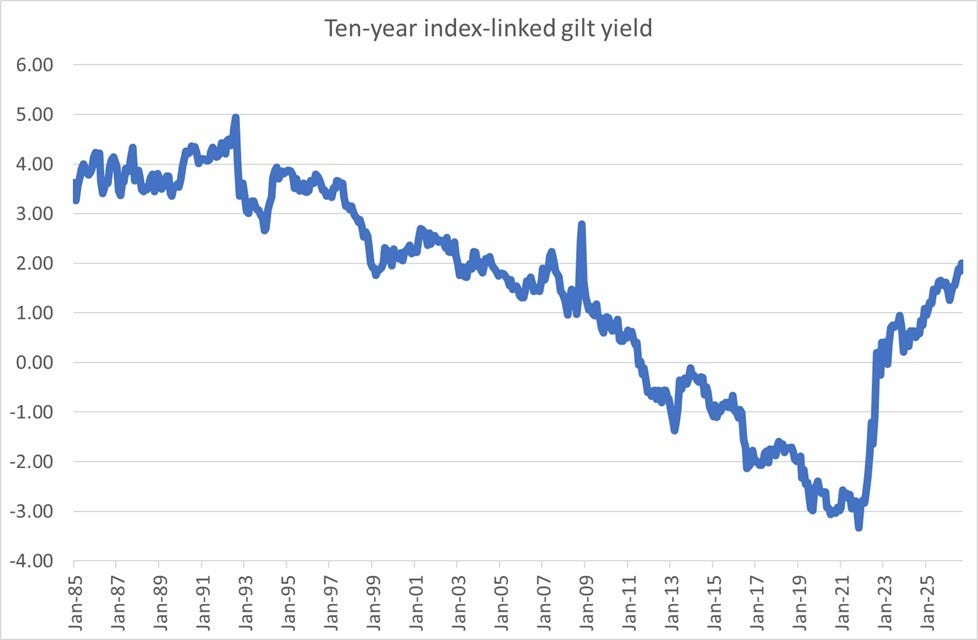
One big fact suggests so. It’s that from the mid-90s until 2022 real gilt yields trended downwards even during times of big government borrowing. And even today the ten-year index-linked yield is lower than it was during the last two occasions when the government ran a surplus: 1988-90 and 1999-01. This is not consistent with government borrowing being exogenous and crowding out private sector investment. But it is consistent with it being the result of an (incipient) excess of private sector savings and dearth of investment opportunities.

Badenoch, however, does not even consider this possibility.

Perhaps, thought, we can forgive her for not doing so. One element of politicians’ professional deformation is a tendency to exaggerate the agency of governments and under-estimate the extent to which they respond to emergent trends - in this case the investment dearth.

Which brings us to another of Badenoch’s blindspots - a lack of awareness of how to create the conditions in which deregulation would be feasible and sustainable. She says:

If people stop trusting one another, every transaction needs more oversight, more regulations, more lawyers.

She’s right. If you want to deregulate you need more trust. But how to create this? It would be naive to hope that rolling back the state would somehow lead to a revival of strong professional and business ethics: you can’t put the toothpaste back in the tube (especially if it wasn’t there in the first place).

We need something else that Badenoch doesn’t mention - more equality of bargaining power. If people can protect themselves we need less regulation. Philippe Aghion and colleagues have shown that strong unions are often associated with less government regulation; it’s no accident that the decline of British unions led to a rise in regulation. Nor is it an accident that many of the countries that score highest on the Heritage Foundation’s index of economic freedom are relatively egalitarian ones; Switzerland, Ireland, Australia, the Netherlands, Sweden and Denmark (to name a few) have both a higher ranking and less inequality than the US.

This points to a different way to deregulate - to inform and empower consumers. Just as we have GPs to advise us which medicines to take, so perhaps we need advisors and advocates to help us buy investment products, insurance, phones, broadband and so on. Such groups would help reduce our often-justified distrust of companies and so facilitate deregulation; they, rather than regulators, would protect us from predatory capitalists.

Badenoch never raises this possibility. She’s trapped in a mindset that sees politics as what governments do to (or for) people - as (in Julian Le Grand’s metaphor) knights rescuing pawns. She says that “government needs to create the conditions for growth” without seeing that these conditions require more than pulling policy levers: they require cultivating an ecosystem of countervailing powers in which a market economy can work for everyone.

Badenoch’s diagnosis, then, contains many blindspots: the degree to which governments operate in a globalized economy; the extent to which capitalist growth has endogenously slowed and investment opportunities diminished; the possibility that policies such as government borrowing are effect not cause; and the fact that policy isn’t about pulling levers but encouraging thriving ecosystems, a big element of which must be the empowering of customers and workers.

But here’s the thing. These flaws are not confined to her, or even merely to the Tory party; we see them in the Labour party too. I’m not sure this is simply because politicians lack brain-power. It might rather be that they, like all professionals, suffer from a form of professional deformation. Or it might be that they are working in the interests of extractive capital. Whatever it is, Badenoch’s ideas are no solution to capitalist stagnation.

Discussion about this post

Ready for more?

  • ✇Chris Dillow
  • Who needs thought? Chris Dillow
    Will Jennings recently blooted:I’m increasingly disillusioned with the (policy) ideas ecosystem in the UK - it seems like underlying (social) scientific research is less and less influential and there’s increasing dominance of PR and pseudo-research.He’s bang right. But the problem is much worse than this. Politics actively rejects serious thinking. We see this not just in the main political parties being happy to see even top universities to decline but also in the main polic
     

Who needs thought?

2026年10月7日 16:59

Will Jennings recently blooted:

I’m increasingly disillusioned with the (policy) ideas ecosystem in the UK - it seems like underlying (social) scientific research is less and less influential and there’s increasing dominance of PR and pseudo-research.

He’s bang right. But the problem is much worse than this. Politics actively rejects serious thinking. We see this not just in the main political parties being happy to see even top universities to decline but also in the main policies of recent years. Fiscal austerity, Brexit or tougher immigration controls all defied the intellectual consensus. And under Starmer the government showed little awareness of fundamental economic ideas such as opportunity cost, regulatory capture, sampling bias, the tragedy of the commons or transactions cost economics; it’s too soon to say whether Burnham’s government will be very much better, but the lack of content in John Healey’s conference speech doesn’t augur well.

All this poses the question: why is politics so resolutely anti-intellectual?

We could blame the media. The right-wing press is mere propaganda, whilst the BBC prefers to report the controversy rather than the facts and does a poor job of reporting economic statistics. The public sphere has suffered a tragedy of the commons, having been captured and destroyed by private interests.

But, but, but. Measured by circulation, newspapers were much more powerful in the 1990s than they are today ( sales of the Sun or Mail were four times as high in 1997 as they are now) but this didn’t stop Gordon Brown engaging with academic research on matters such as central bank independence, the minimum wage, endogenous growth theory or the returns to education. You can make policy intelligently even if you have to get down and dirty to sell it. Blair and Brown knew this; it’s not clear that their epigones do.

Our problem, then, is not just the media.

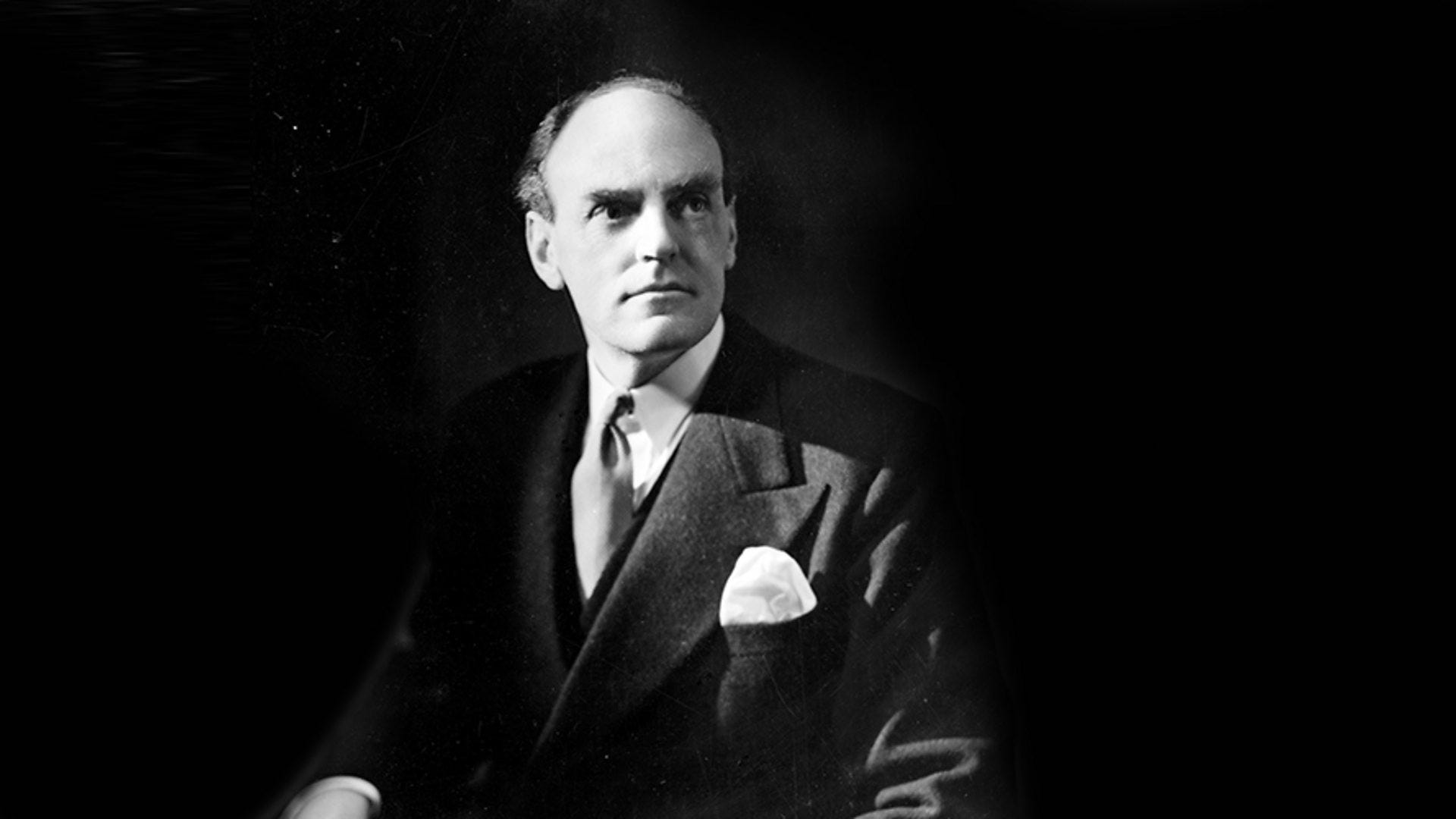
One paradox of our time is that whilst the educational attainment of the population has increased, there has been a decline in public intellectual standards. The BBC’s first boss, Lord Reith, said:

Our responsibility is to carry into the greatest possible number of homes everything that is best in every department of human knowledge, endeavour and achievement.

It is difficult to listen to Chris Mason, Laura Kuenssberg or Jeremy Vine and believe that this remains the BBC’s mission. But the problem isn’t merely its news and current affairs output. Where are today’s equivalents of TV programmes of the 70s and 80s such as Civilization, The Ascent of Man, Age of Uncertainty or the Great Philosophers?

But who would present them? Where are today’s Jacob Bronowskis or J.K.Galbraiths?

If we’re being friendly, we might attribute this loss of public intellectuals to the increased specialization within academia which makes it less likely that somebody can be both a cutting-edge researcher and a great communicator. If we’re being less friendly, we might point to pressure to publish, managerialism, and increased teaching loads as denying academics the space and time to enter the public sphere.

There’s more. One reason why New Labour had such intellectual heft is that it had to at least placate the left and so it had to find policies to show, in Gordon Brown’s words, that “economic progress and social justice can advance together.” Policies such as university expansion, tax credits the minimum wage and even central bank independence were all sold as ways to increase both equality and prosperity. Today, however, the left is marginalized. Politicians need only to placate a few billionaires and political reporters, which naturally has led to a slump in intellectual standards.

The point broadens. The collapse of communism means that western capitalism no longer faces an obvious alternative, with the result that people no longer feel the need to legitimate the system. That has led not only to increased inequality, outright corruption, and the undermining of democracy by billionaires, but also to a lack of interest in defending or improving free market capitalism. Cold warriors needed intellectuals such as Berlin, Friedman or Popper. Today, they can get by with Daniel Hannan.

Here, however, we run into a nasty fact. The west’s victory in the Cold war has led not to a strengthening of liberal capitalism but to the opposite; inequality and stagnation.

Which tells us something - that politicians’ engagement with academic research has not yielded the returns they had hoped. Key New Labour ideas such as central bank independence, a rising minimum wage and university expansion did not lead to better economic growth*. Worse still, this stagnation has caused exactly what Ben Friedman predicted - a retreat into racism and illiberalism.

The result has been that politicians have lost faith in the power of ideas, because it is no longer possible to show that the existing order, with a few tweaks, can leads to economic progress.

What’s more, the response to the rise of the far-right has not been a vigorous assertion of liberal values - the cold warriors’ love of freedom and the open society was insincere - but a kowtowing to irrationalism and an appeasement of “legitimate concerns”. It was a Labour minister (Douglas Jay) who said in 1937 that “the gentleman in Whitehall really does know better what is good for people than the people know themselves.” It’s inconceivable that any of his successors in any party could say such a thing today.

And not just politicians. Academics’ and journalists’ obsession with polling and public opinion betokens a loss of faith in elites’ knowledge and ideas and a deference to a lowest common denominator. This wouldn’t be so bad were it not accompanied by a glaring lack of curiosity. How is public opinion actually formed? Why does it influence policy so much in some areas (immigration) and not at all in others (a wealth tax)? And what are the circumstances in which people really do know better than elites? Such questions are not asked.

A solution to all this would be to escape stagnation, which would have the effect of restoring faith in liberal capitalism and diminishing fascism. But how?

There are in fact, loads of ideas. And there’s a problem with all of them: they all require government to attack vested interests, or what Joel Mokyr called the forces of conservatism. Shifting the tax base from incomes to land would hurt landlords. Simplifying taxes and benefits would put bureaucrats, lawyers and accountants out of work. Stronger competition policy would undermine monopolists’ profits. Empowering consumers would hurt companies that profit from inertia and asymmetric information. More infrastructure investment would alienate nimbys. And so on.

All of which explains Will’s insight. Quite simply, quality research and ideas would be incompatible with British capitalism as it currently exists. When Rosa Luxemburg asked “socialism or barbarism?” she was posing too stark a choice. Ours is between mild reform and barbarism. And it’s not clear which our ruling class will choose.

* “Lead to” is doing some work here. Maybe growth would have been worse without these, but that’s another issue.

Discussion about this post

Ready for more?
  • ✇Chris Dillow
  • Who wants free markets? Chris Dillow
    Thatcherism is dead, in at least one way: hardly anybody now wants free markets. Here are four recent news items: - The LibDems want to cut fuel duty, thereby over-riding the signal from rising petrol prices telling us to consume less of it. - The Russell Group of universities want to raise tuition fees, reminding us that they are a cartel. - Vikki Slade MP wants compulsory registration of barbers and hairdressers, as if customers cannot figure out for themselves whether they’ve had a dec
     

Who wants free markets?

2026年9月29日 16:15

Thatcherism is dead, in at least one way: hardly anybody now wants free markets. Here are four recent news items:

- The LibDems want to cut fuel duty, thereby over-riding the signal from rising petrol prices telling us to consume less of it.

- The Russell Group of universities want to raise tuition fees, reminding us that they are a cartel.

- Vikki Slade MP wants compulsory registration of barbers and hairdressers, as if customers cannot figure out for themselves whether they’ve had a decent haircut.

- Jaguar Land Rover suppliers are asking for government help to switch into producing military and aerospace equipment, as if they cannot achieve a normal response to changing market conditions on their own.

These of course are not the only signs of antipathy towards proper free markets. The moment we left the single market, we showed we didn’t want free trade with our neighbours, a message reinforced by the imposition of high tariffs on steel imports. Immigration controls are a form of manpower planning; an infringement of employers’, landlords’ and universities’ freedom to choose employees, tenants and customers. And the government’s keenness to lock itself into dependence upon Palantir confirms Sam Freedman’s point that “much government business with private providers no longer conforms to anything resembling a functional market.”*

We also see this hostility towards well-functioning free markets in what politicians don’t say. Who has a serious plan to improve the functioning of significant markets? Yes, the Tories talk about deregulation, but they might as well merely shout “abracadabra”: people like deregulation much more in the abstract than in the concrete.

To those of us brought up on Thatcher’s regular praise of free markets, all this is puzzling. It poses the question: why don’t people want free markets?

Granted, there’s much to be said against markets. Many don’t work anything like as well as they do in free marketeers’ fantasies, being riddled with barriers to entry and exit, monopoly power and externalities, and (as we saw in 2008) being a cause of instability. They are often not the liberating devices that Friedman and Hayek thought they were but rather domains in which people bring nothing but their hides and get nothing but a hiding. And of course there are, as Ronald Coase noted, costs of using markets - the hassle of shopping around, changing broadband of energy supplier, looking for new jobs or even merely anticipating one’s future preferences. Transactions cost economics applies to individuals as well as companies.

None of this, though, goes far to explain politicians’ and the public’s move against free markets. If they did, we would be seeing an attack upon monopoly utilities, demands for economic democracy and a push for stronger consumer advocacy groups. But we’re not seeing any of this - perhaps in part because politics has become divorced from any concept of economic rationality.

Instead, there are other reasons why markets are out of favour. One was pointed out by Joseph Schumpeter in 1942. As capitalism develops, he says, large companies controlled by “rationalist and unheroic” bureaucrats squeeze out smaller companies run by entrepreneurs. That leaves fewer people to stand up for the virtues of a free market. Quite simply, the idea doesn’t have a significant client base any more.

This tendency is reinforced by a collective action problem. The beneficiaries of competitive markets are millions of customers who’d get lower prices whilst the beneficiaries of monopoly are large incumbent companies. It’s much easier for the latter to organize to pay lobbyists and to buy politicians by giving them well-paid jobs. And politicians respond to incentives.

But it’s not just incentives that make politicians favour monopoly over competition. So too does their professional deformation.

The case for markets, as Hayek pointed out, is that when they work well they can aggregate dispersed and fragmentary knowledge (pdf) that a central agency cannot have. Politicians, however, tend to underweight this consideration because they are selected to be overconfident about what top-down policies can achieve: you wouldn’t go into politics if it were otherwise.

Nor is it the case that the public are that keen on markets. Yes, well-functioning markets hold down prices. But they come at the cost of creative destruction. And that means uncertainty - job insecurity and the loss of familiar once-loved shops (Wilko is still missed here in Oakham). There’s a tension between economic dynamism and individual security, especially in a political culture hostile to the idea of an intelligent welfare state.

All this poses the question: did anybody ever actually really want competitive markets? Privatization didn’t create them. It was motivated more by a desire to fund tax cuts than create well-functioning markets**. And Thatcher’s biggest attempt at reforming a market - big bang - led to both financial instability and, as Guillaume Bazot has shown (pdf), strong monopoly power. The right claimed to be in favour of markets when doing so was a way of attacking workers’ power, but that support vanished as unemployment fell.

But, but, but. In the right institutional and cultural context markets can sometimes be a useful technology for allocating goods and services. The question is: can we create such a context whist minimizing the economic and cultural costs of using markets? 250 years after the publication of Smith’s Wealth of Nations, this question has fallen off the political agenda.

* Failed State, p 96.

** The main virtue of the process has been to remind us that the form of ownership is separate from the mode of allocation; one can have private ownership without well-functioning markets and, I suspect, vice versa.

Discussion about this post

Ready for more?

  • ✇Chris Dillow
  • Marx on AI Chris Dillow
    Three things I’ve read recently:“We think we’re robotizing our work, but what if we’re actually robotizing ourselves?” (Sarah O’Connor, We Are Not Machines, p11)“We can view people as rule-following. We create more rules. This creates comfort and authority. But it is at the cost of creativity and play”. (Benjamin Recht, The Irrational Decision, p217)“When we create procedures with mechanical rules, we make workers fungible. We no longer need
     

Marx on AI

2026年9月15日 15:40

Three things I’ve read recently:

“We think we’re robotizing our work, but what if we’re actually robotizing ourselves?” (Sarah O’Connor, We Are Not Machines, p11)

“We can view people as rule-following. We create more rules. This creates comfort and authority. But it is at the cost of creativity and play”. (Benjamin Recht, The Irrational Decision, p217)

“When we create procedures with mechanical rules, we make workers fungible. We no longer need to depend on a particular person...We want to use our tools; we don’t want our tools to use us.” (C. Thi Nguyen, The Score, p168, 256)

To which I paraphrase Tonto: what’s this”we” shit, tool of the bourgeoisie? There’s no “we”. There’s us and them or, as Lenin said, “who, whom?” How to use technology, rules or metrics is to a large extent not a decision that will be taken by “us”. Instead, it’ll be taken by some capitalists with regard to their own individual interests, not those of humanity generally.

In using “we” these writers are missing the essential Marxian insight, that the defining feature of capitalism is class division, with capitalists having more power than workers.

This is not some inessential detail. It is a foundational truth. It is the only lens that allows us to see the economy clearly. The application and direction of technical change is determined much more by capitalists than by workers. As Langdon Winner wrote (pdf) back in 1980 “the technological deck has been stacked long in advance to favour certain social interests.”

Technical change has often been used not merely to raise productivity but to shift power from workers to capitalists. Winner gives the example of how expensive machinery was sometimes employed to break trades unions, and Peter Skott and Frederick Guy described how technologies such as CCTV or barcode scanning “have allowed firms to monitor low-skill workers more closely, thus reducing the power of these workers”. And the great Cory Doctorow points out that AI is the apotheosis of the fantasy of Taylorite “scientific” management:

A boss who lays hands upon an AI tool doesn’t have to know how to draw a picture, balance books, or write technical documentation. They only have to prompt the production of these things. For bosses, AI is a great leveler: it is sold as a way to distill and package up the skill and discernment of workers and infuse them into a pliable automaton.

Of course, Nguyen, Recht and O’Connor are far too clever not to see all this. For example, Nguyen writes that “any standardised system serves some set of interests.” And O’Connor asks “who is the ‘we’ who decides” how to use technologies? “We”, she writes, “can conceal more than it reveals.” For, though me they don’t perhaps stress it sufficiently. Issues such as technical change and the applications of metrics are issues of what capitalism does to workers.

Herein however lies an irony. Although O’Connor and Nguyen don’t use an explicit Marxist perspective, they do confirm important Marxian insights.

Nguyen describes what he calls “value capture”, a process whereby our own personal values are supplanted by simplified institutional metrics. He gives the example of restaurants maximizing their Yelp ratings rather than making good food or students caring more about grades than learning. He might also have cited examples provided by John Kay in Obliquity of how companies such as ICI or Boeing began to place more emphasis upon shareholder value than making great products, or Benabou and Tirole’s story (pdf) of how bonus culture causes managers to chase short-term measurable targets and neglect professional values or organizational culture.

What Nguyen is doing here is giving us one mechanism (there are others) to help explain and illustrate Marx’s point:

The ideas of the ruling class are in every epoch the ruling ideas, i.e. the class which is the ruling material force of society, is at the same time its ruling intellectual force. The class which has the means of material production at its disposal, has control at the same time over the means of mental production.

He’s doing something else too. He’s describing one aspect of alienation: how, under capitalism, man “does not develop freely his physical and mental energy but mortifies his body and ruins his mind.” If capitalism is warping our values and perspectives as Nguyen describes, then it is indeed ruining our minds. Even very intelligent people suffer from this: one problem with capitalism today, says John Danaher, is how it “colonizes our mental space”. And anybody discussing how AI might dehumanize us is also echoing Marx.

O’Connor also describes alienation without naming it. She shows how in Amazon warehouses robots bring goods to workers to be packed, with the result that one worker she interviewed “felt more like a machine than ever.” As Marx said, capitalist industry “convert[s] the workman into a living appendage of the machine”.

There is, however, more to alienation than merely (!) boring work and the degradation of our physical and mental faculties. Another aspect of it is that the things we produce appear to have power over us. As Marx wrote:

The object which labour produces – labour’s product – confronts [him] as something alien, as a power independent of the producer…It means that the life which he has conferred on the object confronts him as something hostile and alien...the more the worker spends himself, the more powerful becomes the alien world of objects which he creates over and against himself.

This is what Jacob Coxon was driving at when he claimed recently that there’s a chance that AI could “kill all humans.” Capital, wrote Marx, “is reckless of the health or length of life of the labourer”.

Maybe Coxon was exaggerating. But OpenAI’s hacking into Hugging Face illustrates the point at a less alarming level: AI does indeed appear as a “power independent of the producer”. It is, like Mary Shelley’s Frankenstein, a demon of our own design.

If that phrase is familiar, it’s because it is the title of a book by Richard Bookstaber wherein he describes how man-made mortgage derivatives span out of control, causing a financial crisis. Again, that’s alienation.

In these respects, there’s nothing especially new in AI - a fact we’d better appreciate if we were more alive to Marx’s thinking*.

Here, though, we must avoid a danger. AI, corporate metrics, algorithms or financial products might seem like they control us. But this is an illusion. They merely mediate power relations, the domination of capitalists over workers. Nobody works for an algorithm, however much it might feel as if they do. They work for the people who own and control the algorithm.

You’ll never guess who described this. He called it commodity fetishism, an idea developed into Lukacs’s idea of reification. For Marx, it is the process whereby:

a definite social relation between men...assumes, in their eyes, the fantastic form of a relation between things...To find an analogy, we must have recourse to the mist-enveloped regions of the religious world. In that world the productions of the human brain appear as independent beings endowed with life, and entering into relation both with one another and the human race. So it is in the world of commodities with the products of men’s hands.

Whenever anyone speaks of the impact technology is having upon us they are guilty of commodity fetishism, of failing to see the power relations undergirding the applications of technology.

I must caveat this. Although capitalists have some power over workers, they do not have a completely free hand. As Marx said, they too are subject to the “external coercive laws” of the market. These laws are not merely those of product market competition. They also come from capital markets. Charles Prince, CEO of CItigroup expressed this well just before the financial crisis when he said:

When the music stops, in terms of liquidity, things will be complicated. But as long as the music is playing, you’ve got to get up and dance. We’re still dancing.

The same thing might be happening with AI investments. There’s a form of arms race; everyone is investing heavily for fear of missing out and (as with Citigroup) for fear of incurring the wrath of equity markets if they lag behind. What’s rational for each individual is not necessarily rational for capitalism generally. As Marx put it, “the individual capitalist is in constant rebellion against the general interests of the capitalist class as a whole**.” Anthropic CEO Dario Amodei is clever enough to see this. His call for “industry-wide coordination” to slow down investment reflects the fact that the industry has a collective action problem that can only be solved if companies collude to curb spending.

My point here is not to criticize Recht, Nguyen or O’Connor as individuals. Quite the opposite: I learned a lot from their work. Instead, it’s a story about our intellectual culture. Since the end of the cold war, Marxism has been erased from it. And this has been a tremendous loss, because it’s hard to understand capitalism without Marxism. The result has been an impoverishment not only of politics (every party lacks an analysis of capitalism) but also of our intellectual life, with even our cleverest people not appreciating that they are using Marxian concepts. The upshot is that people feel the need to reinvent the wheel rather than realize that we have a useful pre-existing body of knowledge. You can marginalize Marxism, but you cannot marginalize the facts.

* Recht is good on how the basic ideas behind AI are old: AI has developed in recent years not because of new theories but because of greater computing power.

** Contribution to the critique of political economy, cited in Elster, Making Sense of Marx, p189.

Discussion about this post

Ready for more?
  • ✇Chris Dillow
  • Good policies, bad politics Chris Dillow
    Here are a few oddities about public opinion: - Only 21% of voters think Brexit was “more of a right turn”, but 46% support Brexit parties: the Tories, Reform or Restore. - Although both net migration and the numbers arriving in small boats have fallen, voters still say that immigration remains most the important issue, with more mentioning it now than did so in 2022-23. - London’s Ulez zone has improved children’s lung health and saved lives. But despite this (and desp
     

Good policies, bad politics

2026年9月7日 19:53

Here are a few oddities about public opinion:

- Only 21% of voters think Brexit was “more of a right turn”, but 46% support Brexit parties: the Tories, Reform or Restore.

- Although both net migration and the numbers arriving in small boats have fallen, voters still say that immigration remains most the important issue, with more mentioning it now than did so in 2022-23.

- London’s Ulez zone has improved children’s lung health and saved lives. But despite this (and despite a fall in crime) more Londoners say Sadiq Khan is doing a bad job than a good one, and James Cleverly thinks he can win support by complaining about a “war on motorists”.

We can add to this the fact that the Tories and LibDems haven’t sunk into the oblivion they deserve because of the ongoing consequences of austerity, be they the need to release prisoners early to prevent overcrowding; low military spending; the near-collapse of local government; the failure to address the problems of social care; the inability of the police on Teesside or in Kent to maintain public order; or a large backlog of NHS maintenance spending. Yes, the centre-right has disappeared, but because of Brexit, not revulsion at its vandalism.

What all this tells us is that good policy is not the same as good politics. Good policy doesn’t necessarily win votes and bad policy doesn’t lose it. Sometimes, in fact, the opposite.

We can add other examples. The post-war settlement, which was largely created by the Labour party, created affluence and consumerism which fuelled the individualism that led to the rise of Thatcherism. As David Butler and Richard Rose wrote after Labour’s 1959 election defeat:

Full employment and the welfare state have made the well-paid worker much less dependent on his trade union or on the Labour party than before the war...He may well think of himself as a consumer first and only secondly as a worker. (Quoted in David Kynaston, Modernity Britain, p429)

Similarly, New Labour in 1997-2010 did a good job of reducing pensioner poverty - so good, in fact, that pensioners felt emboldened to vote Tory*.

Thatcherism itself ran into the same problem. It was so successful in defeating trades unions that voters were no longer frightened of “union barons” and so returned to Labour.

Now, I’m not saying that good policy is always an electoral failure or bad policy guaranteed to win votes. You might think of two obvious counter-examples: sterling’s ejection from the ERM in 1992 and the Truss Budget of 2022 both wrecked the Tories’ reputation for economic credibility and led to big election defeats.

But, but, but. What’s remarkable is that in both instances they had a reputation to lose. In 1992 two severe recessions (in 1980 and 1990) had not wrecked that reputation, and yet a move that paved the way for years of good growth did do so. And in 2022 a decade of austerity had not ruined the Tories’ economic credibility. All of which tells us that governments can remain popular with at least some policies that are terrible from a technocratic point of view.

All of this is compatible with a theory of political entrenchment proposed (pdf) by Gilles Saint-Paul and colleagues. Political parties, they argue, want to ensure that their supporters continue to have a grievance so they continue to vote for it. A leftist party that succeeded in eliminating poverty, or a rightist one that defeated the unions and cut immigration to nothing, would lose the basis of its support. And so failure works better than success.

If you’re selling protection against a bogeyman you need to keep it alive: kill it, and you’ve lost your selling point.

This point hasn’t been lost on today’s right. With immigration numbers falling, the bogeyman can no longer be the threat of migrants coming here. So they must change it to the migrants who are already here: hence the need to pretend that London is a crime-ridden hellscape and that asylum seekers are sexual predators.

What matters in politics isn’t “good” policies. It’s the ability to create client groups.

Parties have succeeded when they’ve built coalitions of such groups, be they Labour’s post-war alliance of many (but not all) trades unionists and wealthier liberals or Tory coalitions of new and old money. They’ve also succeeded by building new groups, as Thatcher did by creating new home-owners with an interest in maintaining low interests rates.

By this token, Reform is only half-successful. It has won a client base of reactionary preponderately older votes but this alone only gets it a maximum of 25-30% of the electorate.

Serious political failures occur when parties lose such groups. The Tories have lost the votes of many of the affluent professionals and businessmen that were traditionally its core support: Sir Lancelot Spratt was no doubt a Tory, but senior doctors today are less likely to be. And Starmerites’ failure has been to tell Labour’s client base of metropolitan liberals to fuck right off.

What I’m trying to do here is to lean against a conception of politics to which educated people are especially prone, and from which Farage’s lack of education immunises him. It’s the tendency to see politics as like sitting an exam in which the best answers get the best marks. It’s not. The correlation between good policies and electoral success is low, and sometimes negative. Instead, political success comes from creating loyal groups. Criticising Reform for its incompetence or unworkable policies is a form of category error; they’re not aiming for technocratic government, but at the creation of a clientele.

Which leaves us with a problem. In well-functioning systems there is negative, stabilising feedback. If a room is too cold the thermostat switches on the heating; if a product is over-priced lack of demand will cause its price to fall; if a species multiplies too much it will deplete its food source and so its numbers will fall. And so on.

Such stabilising feedback does sometimes exist in politics, as we saw with the swift reversal of the Truss Budget. In the examples I’ve considered, however, we have the opposite - positive feedback. So, for example, the massive costs of public spending cuts have not led to a clamour for their reversal, whilst falling immigration has led to demands for even more attacks upon migrants.

This is a symptom of a profoundly dysfunctional system.

* Labour’s policy success arguably did more electoral damage than its greatest policy failure: the party was re-elected with a large majority two years after the Iraq war.

Discussion about this post

Ready for more?

  • ✇Chris Dillow
  • Buying politicians Chris Dillow
    Money talks. That seems to be the message of Andy Burnham opposing a tight limit upon political donations. His stance has outraged many people. But what exactly is the problem here?I ask because the money involved in politics is from one perspective quite small. For example, if the 600,000 people who attended the largest pro-Palestine march last year had put just £10 into a kitty they’d have raised £6m - 12 times the value of the “hospitality” MPs have received thi
     

Buying politicians

2026年8月27日 16:02

Money talks. That seems to be the message of Andy Burnham opposing a tight limit upon political donations.

His stance has outraged many people. But what exactly is the problem here?

I ask because the money involved in politics is from one perspective quite small. For example, if the 600,000 people who attended the largest pro-Palestine march last year had put just £10 into a kitty they’d have raised £6m - 12 times the value of the “hospitality” MPs have received this year. Or if just 5% of voters could pay £5 per month into a political fund this would be worth over £130m a year - more than all political parties received last year.

These numbers suggest we have a collective action problem. Small sectional interests - those of companies or rich cranks - can organise and raise money easily. Larger, dispersed interests by contrast are harder to organise and so don’t get a say. The upshot is that MPs are being bribed by the wrong sort of money - that representing small groups wanting special favours, sometimes to the detriment of the general interest.

What if this collective action problem could be solved - if we had, say, citizen advocacy groups who could, cough, lobby MPs on behalf of a wider and more representative range of interests? What would be wrong with this?

An obvious answer is that even a more equal bidding war for influence would still be undemocratic. Democracy, if it is a valuable ideal at all, is the principle that we should all have equal opportunity for political influence. That’s incompatible with MPs being bought even by groups more representative of the people. Hence the outrage at them being bought by anybody.

This line, however, argues for truly radical political change. Equality of influence is incompatible with, for example, the media being owned and controlled by a tiny minority or with politicians being selected for having a distorted view of the world.

Let’s put aside the arguments for or against such changes and ask instead: would introducing more money into politics would actually be a step towards such an ideal*? From our imperfect world, what would be wrong with this step? The answers shed some light on our attitudes beyond politics.

One thing that’s wrong with it is that we don’t like the cash nexus to be so naked. Just as some people might sleep with a man if he buys them dinner but not if he offers them £100 directly, so MPs might not be amenable to direct cash offers. They’re happy to offer “access” and the opportunity to be persuaded, but not to be overtly asked to change their vote in exchange for cash. To paraphrase (apocryphally) George Bernard Shaw, we know what MPs are; we just have to frame the proposal properly.

Many, however, would not change their vote for cash: even if we could outbid Harbourne’s £5m we could not thereby turn Farage into a decent human being. It is only at the margin that financial incentives change behaviour, More often, they reinforce our existing dispositions. Most of us want to do a decent job because of self-respect or a desire to show off; money helps us do so.

And incentives can backfire. They can crowd out intrinsic motivations; bankers who were motivated by big bonuses, for example, drove their companies into insolvency. Bringing even more money into politics might discourage MPs from thinking about legislation, and would attract unprincipled candidates who would merely vote for the highest bidder.

What’s more, money from groups representing honest collective interests might not carry much weight. It’s possible that MPs are attracted to current donors not merely because they have cold hard cash but for other motives.

Adam Smith saw one: the “disposition to admire, and almost to worship, the rich and the powerful”:

We frequently see the respectful attentions of the world more strongly directed towards the rich and the great, than towards the wise and the virtuous. We see frequently the vices and follies of the powerful much less despised than the poverty and weakness of the innocent....The great mob of mankind are the admirers and worshippers, and, what may seem more extraordinary, most frequently the disinterested admirers and worshippers, of wealth and greatness.

This deference is reinforced by the fact that MPs, being more ambitious than most of us, are especially impressed by wealth and by the ability to rise to the top of corporate hierarchies - by what Alasdair MacIntyre called external goods.

To the extent that this is the case, they’re swayed by wealth not so much because of what it buys but because of what it represents - wordly success. Money coming from citizens’ advocacy groups would not carry such meanings and so would be less influential even if it were a larger sum. This is perhaps why donations from trades unions don’t buy as much influence, pound-for-pound, as those from rich individuals.

Even if all this were wrong, however, there’d still be a reason not to use citizens’ lobbying groups to funnel money to politicians. It’s that part of the purpose of politics (maybe a large part) is not simply to buy one’s preferred policies as we’d buy a pound of mince. Instead, political acts have what Robert Nozick called symbolic utility: they symbolise who we are and what we value. People don’t go on demonstrations to change policy: they rarely do so even when the demonstrators are correct. Instead, they go on them to, well, demonstrate - to show what type of person they are. Demonstrations symbolise particular values - the importance of specifically political activity, of solidarity, and a rejection of the transactional consumer-oriented politics that we’d have if money simply bought politicians**.

I don’t want to reject this: a life without symbolic utility would be a horribly arid one. But there’s a cost of pursuing it. Just as the symbolic utility of being a good parent might mean sacrificing some instrumental utility of having more money or relaxing nights out, so in politics the symbolic utility of demonstrating and activism might entail a sacrifice of making progress towards egalitarian policies.

But here’s the problem. Our opponents don’t feel the force of this trade-off. Bosses of utilities, gambling companies or fossil fuel companies don’t feel any need to build solidarity or show that they are good people, and so they can get on with the work of buying influence quietly.

For these reasons, what we have is to some extent a sham democracy, a facade behind which capital - and often the most regressive parts thereof - exercise dominant influence. And this would be the case even if political donations were to be limited.

* If the ideal is desirable, which is another matter.

** Of course, it’s not just the left that pursues symbolic utility. I suspect a lot of mainstream policies have symbolic rather than instrumental utility: fiscal rules, the criminalisation of hard drugs, or a rising minimum wage, for example. And many of Reform’s policies aren’t intended to be solutions to practical problems but rather to symbolise the sort of people Reform are, and the sort of voter they want.

Discussion about this post

Ready for more?
  • ✇Chris Dillow
  • The politics of Cher Chris Dillow
    Which 1980s thinker has the most influence on today’s politicians? It’s not Hayek or Friedman or Rawls or Negri or Laclau. Nope. It’s Cher. “If I could turn back time” is the motto of much of our political-media class.This is most obviously true of proposals for remigration and mass deportations, which are not a serious response to any socio-economic problem but merely a desire to turn back time to when the UK was more ethnically homogenous. It’s also true of
     

The politics of Cher

2026年8月19日 15:36

Which 1980s thinker has the most influence on today’s politicians? It’s not Hayek or Friedman or Rawls or Negri or Laclau. Nope. It’s Cher. “If I could turn back time” is the motto of much of our political-media class.

This is most obviously true of proposals for remigration and mass deportations, which are not a serious response to any socio-economic problem but merely a desire to turn back time to when the UK was more ethnically homogenous.

It’s also true of Burnham’s urge to turn back 60 years of deindustrialisation and to reindustrialise the country, despite the fact that the management and labour skills we need to do so have vanished, insofar as they ever existed in the first place.

The widespread indifference to the collapse of universities is another example. As are proposed cuts in targets for sales of EV cars, plans for more drilling in the North Sea and (in the case of Reform) a refusal to accept the realities of climate change.

We could add Brexit to this. It was never a solution to any problem but rather an atavistic urge to return to a time when Britain or the UK (Brexiters have never been clear about what our country actually is) stood alone in the world.

Granted, the government does have an AI strategy, but this might be less a sign of a realistic embracing of the future than it is like a bunch of children impressed by a conjuring trick.

Our political class want to return us to an era when white men would leave their factory shift at companies such as Tube Investments or Hawker Siddeley, get in the Austin Allegro and go home to wives wearing crimplene* who had their Findus crispy pancakes waiting for them.

This desire to return to the past is a sharp contrast to our most successful politicians who have instead looked to the future. Harold Wilson’s official government profile says “his main plan was to modernise”. He presented himself as a modern technocrat against the amateurish old-fashioned Old Etonian Douglas Home** who wanted the “white heat of the technological revolution” to sweep away “out-dated practices”. Thatcher opposed state intervention in industry in part because it protected “yesterday’s industries, yesterday’s processes and yesterday’s products”, and she wanted to break trades unions in order to give managers the opportunity to modernise workplaces and embrace new technologies. And Blair couldn’t open his mouth in the 90s without talking of modernisation. As Alan Finlayson wrote in Making Sense of New Labour:

If there is a single word that might capture the essence of New Labour’s social and political project then it is ‘modernisation’.

Why, then, are today’s politicians so keen to return to the past when their predecessors succeeded by looking to the future?

For all Burnham’s talk that “in the 1980s, Britain took some wrong turns”, I don’t think it’s because they view the 60s and 70s as a template. They don’t want the tax rates, strong trades unions or extent of nationalisation that we had then.

Instead, they’re looking to a selective picture of the past because they cannot face today. Michael Oakeshott got it right. “If the present is remarkably unsettled”, he wrote , there’ll be “a recourse to and an exploration of the past.” Our true problems are difficult ones: economic stagnation; climate change; overpriced housing; inequalities of economic power; and a degraded public sphere that precludes rational politics. Rather than face these, politicians and the media are instead yearning for a (partly mythical) past.

This is because they simply don’t have the tools to deal with them.

Herein lies a difference between the modernising political projects of the past and the one we need now.

For Wilson, Thatcher and Blair “modernity” required that other people change: old boy dilettantes, trades unions, public sector workers or the left. Today, however, modernity requires that politicians themselves change.

It requires them to see that the lobbyists and vested interests they listen to are the “forces of conservatism” that are holding back economic growth. Reviving economic growth (if it is possible) requires, among other things, that we attack monopoly power, shrink the financial system, and simplify the tax system. But this would alienate corporate lobbyists.

It also requires them to recognise that the mass media is not only the enemy of decency and rationality but also a terrible guide to reality and public opinion, because it no longer aims at a mass market but is instead a few billionaires’ gimps writing for a handful of cranks. Kowtowing to the press is turning back time to when it mattered. What we need instead today is a reconstruction of the public sphere.

And it requires them to think less about mythical “policy levers” and instead about growing new ecosystems, be they forms of economic democracy, better functioning markets or consumer advocacy and advice groups that could act as countervailing power against powerful companies.

In short, politicians themselves must slough off the professional deformation which blights even the best of them: their excessive faith in top-down managerialism and regulation; their reluctance to challenge the constraints which regressive sections of capital tries to impose on them; or their neglect of the importance of emergent social phenomena. We need decentralisation not merely to local mayors, but to individuals - be it in the form of better-functioning markets, powerful consumer advocacy groups, or economic democracy.

Right now, the political-media class not only does not want to do this but barely even recognises than it is an issue. Like Cher, it would much rather turn back time - the difference being that at least Cher knew this cannot be done.

* A British invention.

** The only British PM to have played first class cricket.

Discussion about this post

Ready for more?

  • ✇Chris Dillow
  • Stagnation: the norm Chris Dillow
    “To understand the man you have to know what was happening in the world when he was twenty” said Napoleon. He was right - a fact which suggests many economists might be overconfident about how quickly the economy might grow even with the very best policies.Most of us over the age of 40 were educated to take economic growth for granted. Of course, we knew recessions were inevitable from time to time, but these were dips in a rising trend of prosperity. Between 1945 and 2005 real GDP
     

Stagnation: the norm

2026年8月12日 17:04

“To understand the man you have to know what was happening in the world when he was twenty” said Napoleon. He was right - a fact which suggests many economists might be overconfident about how quickly the economy might grow even with the very best policies.

Most of us over the age of 40 were educated to take economic growth for granted. Of course, we knew recessions were inevitable from time to time, but these were dips in a rising trend of prosperity. Between 1945 and 2005 real GDP per person grew on average by 2.3% a year, which meant that a young adult earlier this century was three times better off than his grandparents were.

But, but ,but. Such growth was historically unusual. Before 1945 trend growth was usually below 1% a year. The industrial revolution was a miracle that lifted us out of abject poverty, but it was a slow process.

Our faith that 2%+ growth is achievable might therefore owe less to historic evidence and more to the psychological tendency to regard the age we grew up in as the normal one.

In fact, we have many reasons to think that low growth - verging on stagnation - is indeed the norm, especially for a moderately rich country.

Certainly, classical economists thought so. John Stuart Mill wrote in 1848:

It must always have been seen, more or less distinctly, by political economists, that the increase of wealth is not boundless; that at the end of what they term the progressive state lies the stationary state, that all progress in wealth is but a postponement of this, and that each step in advance is an approach to it.

For thinkers from Smith to Mill, economic growth was a race between diminishing returns and technical progress which would eventually be won by the former. “Eventually” might have arrived. We’ve picked much of the low-hanging fruit which means good ideas are harder to find. “Research productivity is declining sharply” found (pdf) Nick Bloom and colleagues, a finding corroborated (pdf) by Philipp Boeing and Paul Hunermund. What’s more, bosses have now learned the lesson (pdf) of William Nordhaus that companies capture only a “miniscule fraction of the social returns from technological advances”, and so are less incentivized to make them. Such slower technical progress cannot be offset by faster capital accumulation, given that we need a heck of a lot of it to raise output even by a little.

This tendency is exacerbated by another, pointed out by Dietrich Vollrath in Fully Grown. All economies shift from manufacturing to services as they mature, and this alone would reduce aggregate growth simply because it’s harder to make productivity gains in services than manufacturing.

There’s another reason why economic growth is slow. It requires labour and capital to move from less productive uses to more productive ones. And this change is necessarily slow simply because people take time to adjust; take time to learn of new opportunities or to gain new skills; and need time to not only install capital but to learn how best to use it. These reasons lay behind slow growth in the 18th and 19th centuries. Yes, there were some very dynamic industries but these were small and so their growth added little to aggregate growth: whist the 883,000 people working in the textiles industry in 1841 were becoming more productive, the 1.2 million in domestic service were not.

If AI is anything like all preceding technologies, this will be true of it too. Whilst there’s early evidence that productivity is rising in AI-producing sectors, there’s so far less evidence of it doing so in AI-using ones. That’s consistent with what we saw of other general purpose technologies such as steam power and electricity; it takes many years for them to greatly raise output.

On top of these technical forces there is also a cluster of social forces restraining growth. Joel Mokyr has written:

Technological creativity is a delicate and fragile flower that needs just the right institutional environment to thrive. Yet in a truly dialectical manner, its very success usually destroys the environment it needs to survive.

A prosperous society is one in which there are many people who are content with their lot and who don’t want to jeopardise it with the creative destruction that is economic growth. And so “the forces of conservatism” writes Mokyr “manage through a variety of legal and institutional channels to slow down and if possible stop technological creativity altogether.”

Some of these forces are company bosses themselves who focus on entrenching their incumbent power by buying out potential rivals, aggressively protecting their intellectual property or lobbying for favourable regulation. Managing a growing company is difficult because lots can go wrong (which is why growth stocks have traditionally been overvalued by investors) so why bother when you can opt for the quiet life instead?

As Joseph Schumpeter wrote, managers in big companies tend to be “rationalist and unheroic” bureaucrats rather than entrepreneurs, and lack the dynamism to drive growth.

But it’s not just bosses. There are also nimbys wanting to protect their house prices, a financial sector that benefits from the low real interest rates caused by stagnation, or lawyers and accountants who oppose tax simplification.

How can these people wield so much power against the wider public interest in raising growth? The answer lies in a point made by Mancur Olson in The Rise and Decline of Nations. Small groups find it easier to coordinate than large ones, and so pressure groups form among sectional interests rather than among larger dispersed interests. That leads to lobbying for special favours, protection and tax breaks, all of which accumulate over time to clog up the economy. Meanwhile, the dispersed interests in the sort of things that might raise growth - competitive markets, a simple tax system, more efficient procurement and infrastructure spending - do not organize themselves into lobbying groups and so don’t get a look in.

Maybe, therefore, we should regard stagnation as the norm, even before we think about other forces suppressing growth such as climate change, inequality or an ageing population.

None of this is at all radical. I’ve cited only mainstream thinkers, and I’m ignoring the possibility that inequalities of wealth and power hold back growth, or Marx’s idea that:

At a certain stage of development, the material productive forces of society come into conflict with the existing relations of production or – this merely expresses the same thing in legal terms – with the property relations within the framework of which they have operated hitherto. From forms of development of the productive forces these relations turn into their fetters.

Instead, the point is that pessimism about economic growth, especially in mature economies, is a strong intellectual tradition. Conversely, optimism might be based less upon evidence and more upon the accident of our upbringing. After WWII there was a concatenation of circumstances uniquely favourable to fast growth: a backlog of civilian innovations; a need to rebuild housing and physical capital; declining trade barriers; an absence of major financial crises until 1973; strong wage growth encouraging capital-labour substitution and (perhaps) a confidence that aggregate demand would remain high thereby justifying big capital spending. These circumstances, though, were only temporary. But because we happen to have been born into them, we assume them to be normal. Which they were not.

Now, you might reply here that the UK’s economic performance is so bad that it should be easy to improve it simply by learning from overseas best practice. We don’t need clever ideas; we simply need to stop doing stupid shit.

What this misses, however, is that “stupid shit” is endogenous. The political obstacles to intelligent policy-making are themselves rooted in economics. Stagnation has fuelled a reactionary backlash against liberal migration, funding of universities and membership of the single market. Our economic maturity has created powerful “forces of conservatism” opposed to economic change. And the collective action problem means that sectional interests defeat the general interest.

We can draw two possible inferences from this. One would be to learn to live with stagnation, which means finding some way of beating the far right, the rise of which is itself a symptom of stagnation. The other is to recognise that restoring economic growth requires some very radical changes, if only to create the conditions in which sensible technocratic policy-making is even possible. What is clear, though, is that centrist tinkering isn’t enough.

Discussion about this post

Ready for more?

  • ✇Chris Dillow
  • On the ownership of assets Chris Dillow
    Why did Gianni Infantino’s plan to sell a stake in the World Cup fail? Which company in Europe is the largest owner of forests? These two questions are related - and are in turn connected to a case for much wider public ownership of countries.Infantino’s plan failed because, despite being the nominal boss of Fifa, he did not actually have the power to deliver a meaningful World Cup to outside investors. In threatening to withdraw from the competition, European national football asso
     

On the ownership of assets

2026年8月3日 20:09

Why did Gianni Infantino’s plan to sell a stake in the World Cup fail? Which company in Europe is the largest owner of forests? These two questions are related - and are in turn connected to a case for much wider public ownership of countries.

Infantino’s plan failed because, despite being the nominal boss of Fifa, he did not actually have the power to deliver a meaningful World Cup to outside investors. In threatening to withdraw from the competition, European national football associations were able to prevent a worthwhile event: a World Cup without Spain, France, Germany or England would not be much of a spectacle.

This is an example of a longstanding issue in economics. It’s the so-called hold-up problem. It occurs whenever somebody can hold up production by withdrawing their supplies in order to get their own way. European FAs threat to not participate in a World Cup meant that Infantino didn’t have the power he thought he had.

Companies face this problem all the time. Suppliers of essential parts or labour can threaten to hold up production by withdrawing their efforts and so extract extra income for themselves.

Often, a solution to this is simply to write contracts compelling such parties to provide goods and services at a set price. But this isn’t always possible. Contracts often cannot fully foresee all contingencies or fully specify the precise quality to be supplied (footballers can’t be forced by contract to play well) and even if they can it takes millions of pounds and lots of management time to enforce them. This, I suspect, was Infantino’s problem; he didn’t have a contract compelling national associations to compete in a changed tournament*.

Where contracts are incomplete or unenforceable except at high cost, companies have another solution - ownership. If they buy the supplier they can replace a contractual relationship with a command-and-control one. That, said Ronald Coase (pdf), is why companies exist at all: sometimes market contracting is so expensive.

This is why the same companies own oil drillers as well as refineries or why Tesco has a large fleet of lorries rather than rely on subcontractors. And it answers our second question. Ingka holdings, who own many Ikea shops, is also a huge owner of forest land - 495,000 hectares. Such ownership gives the world’s largest user of timber a guaranteed supply, thereby reducing the hold-up problem. All these are examples of what Oliver Hart and John Moore wrote in a classic paper (pdf): “assets that are highly complementary should be owned together.”

But by whom? It doesn’t matter whether the oil driller owns the refinery or vice versa. But in other cases it does matter. This is because it’s not just owners of physical assets that can hold up production. So too can owners of human capital. The textbook example (pdf) is that of Saatchi & Saatchi. In 1994 shareholders wanted to dismiss Maurice Saatchi as chairman, resenting his high pay and failure to cut costs. Saatchi walked away to form a new company, taking many employees and clients with him. Saatchi and Saatchi went into decline. Those shareholders made the same mistake as Infantino. They thought formal control meant real control. It didn’t. Power lay not with them but with Saatchi.

In these cases the solution is for powerful agents to own the company. As Hart and Moore say, “If an agent is indispensable to an asset, then he should own it.” And again, this is what what often happens**. Business founders own their companies because they are indispensable, say because they have especial knowledge of the production process or have clients personally loyal to them. And many human capital-intensive companies such as law, accountancy or vets practices are owned by partners because if they were mere employees they might do a Saatchi and leave, taking clients, knowhow and colleagues with them.

Powerful agents shouldn’t own companies merely because they could hold up production if they didn’t. They should also do so for a related reason. We want assets to be controlled by those best able to mazimize their value. Because essential people are best able to do this, it is they who should be in control. To incentivize them they should be, in the jargon, the residual claimant - the ones who get what’s left after contracting parties (banks, bond-holders, employees, suppliers etc) have got what the contract specifies. If the company does well, the residual claimant gets big profits, and if it does badly they lose. Incentives should align with the power to make the most difference. And often they are, as when partners or business founders own the company.

The hold-up problem, and its close cousin the residual claimant theory, therefore helps explain lots of what we see about how assets are owned.

But, but, but. There are many issues here. I’ll name just a few.

One is that the residual claimant sometimes isn’t the agent that can maximize the value of the company. External shareholders are residual claimants in that they get what’s left of the company after other creditors have their pickings. But they can do a poor job of maximizing the value of the company because they do not exercise adequate control of management. This is one reason why we had a financial crisis in 2008: shareholders didn’t stop banks from holding bad assets. It’s not accident that building societies which had thrived for decades under mutual ownership collapsed after only a few years with external shareholders.

This problem is an old one. Back in 1989 Michael Jensen wrote:

The idea that outside directors with little or no equity stake in the company could effectively monitor and discipline managers who selected them has proven hollow at best...Institutional investors are remarkably powerless.

The publicly quoted company, he wrote, “has outlived its usefulness in many sectors.” And he was right. Rene Stulz and Kathleen Kahle have documented how the number of companies listed on US stock markets has declined markedly since the 70s with the result that those markets, dominated by a few colossal companies, are less representative (pdf) of the US economy than ever before.

Whilst Jensen’s diagnosis was excellent, however, his prescription has been less so. He wanted managers to have stronger incentives to maximize the value of companies and so favoured things like leveraged buy-outs that would give bosses bigger stakes. We know now, however, that these incentives can causes bosses to chase short-term rewards (pdf) to the detriment of the longer-term health of the company, and can crowd out erstwhile non-financial motivations such as the desire to be a good steward.

Of course, this wouldn’t matter much if the value of a company were merely a private matter between consenting adults. But in important cases it is not, because there are externalities. We saw one in the financial crisis, when the collapse of banks hurt not just shareholders but us all; not only did it cause a recession but it also exacerbated long-term economic stagnation which itself contributed to Brexit. Climate change is another example: the social value of (say) oil companies comprises not just the oil they produce but also the emissions that cause climate change. As Colin Meyer has written (pdf):

Shareholders are not...by any means the only party exposed to the misfortunes of corporations and the more...we strengthen the rights and powers of shareholders, the more we threaten the interests of others.

In a sense all of us are residual claimants upon companies that spew out unpriced or underpriced externalities, be they the risk pollution of banks or the environmental pollution of water companies or the existential danger of catastrophic climate change. In principle, governments could internalize these externalities by taxes or regulation - in effect, pseudo-contracts that shift residual claimancy back onto their owners or managers. In practice, this hasn’t happened. Which opens up a possibility: if we are residual claimants upon banks and other polluters, shouldn’t we have an ownership stake as other ordinary residual claimants do?

Something else reinforces this question. Let’s go back to Hart and Moore’s claim that “if an agent is indispensable to an asset, then he should own it.” In most cases, each individual worker is not indispensable. But collectively, workers are indeed indispensable; if they were to all go on strike, production would cease. The hold-up problem re-emerges. As Hart and Moore say:

What happens if a whole group of agents are indispensable to an asset? In this case, one (or more) of the group should always be given control over the asset.

This is close to what Marx thought. He thought that the working class would grow so powerful that it could eventually act like a single agent, causing a hold-up problem for capital as a whole and so demonstrating its indispensability and hence claim to ownership:

The advance of industry, whose involuntary promoter is the bourgeoisie, replaces the isolation of the labourers, due to competition, by the revolutionary combination, due to association. The development of Modern Industry, therefore, cuts from under its feet the very foundation on which the bourgeoisie produces and appropriates products. What the bourgeoisie therefore produces, above all, are its own grave-diggers.

This didn’t happen because of the collective action problem. It’s difficult to get people to act as one and so the working class has not been able to demonstrate its collective indispensability. The economic logic for collective ownership which Marx thought would emerge has not therefore done so. And so capitalism, in some form, has survived. It is insufficiently appreciated that the economics of asset ownership has wider applications than generally realized.

* In this sense, the tragedy of Infantino is similar to that of Shakespeare’s most sympathetic tragic hero, Shylock. Just as Shylock failed to see that he needed a more complete contract than he had if he were to extract a pound of Antonio’s flesh, so Infantino didn’t realize that he needed a contract compelling national teams to play in a privatized tournament. Both are guilty of not appreciating Coase’s insight that contracts are often imperfect - though Shylock at least had the defence of having lived 300 years before Coase wrote.

** Such agents don’t always own the company if they can extract what they want by their strong bargaining position. This is why footballers don’t own football clubs, why bankers don’t own banks, and why powerful trades unions in the 60s and 70s rarely pushed for ownership stakes. There are however drawbacks to such non-ownership: larger football clubs are owned by reputation launderers and banks are vulnerable to crises.

Discussion about this post

Ready for more?

  • ✇Chris Dillow
  • Social care: the fight for economic thinking Chris Dillow
    At last we have a Prime Minister who understands what the purpose of government should be in a free society. That’s the message from Andy Burnham saying he wants “substantial change” to social care.Right now the system is, as Dan Neidle says, an “insane” gamble. If you have more than £23,250 you must pay all the costs of social care yourself. Which means you might have to pay tens of thousands of pounds and lose your house, depending on the luck of your healt
     

Social care: the fight for economic thinking

2026年7月29日 16:11

At last we have a Prime Minister who understands what the purpose of government should be in a free society. That’s the message from Andy Burnham saying he wants “substantial change” to social care.

Right now the system is, as Dan Neidle says, an “insane” gamble. If you have more than £23,250 you must pay all the costs of social care yourself. Which means you might have to pay tens of thousands of pounds and lose your house, depending on the luck of your health. For very many people this gamble is a horrible prospect. They’d like to insure against it. But the private sector doesn’t offer such insurance. That’s an egregious market failure.

Enter the state. In a free society the function of the state should not be to tell children what to do after bedtime or tell adults what toilet to use. It should rather be to do what individuals cannot do for themselves. And the private sector cannot provide the insurance against massive financial losses that many people would like.

Why not?

One reason is adverse selection. Younger people don’t want such insurance because the risk seems to be years away. Only those approaching the danger, or who are just starting to buy social care, want to buy it. But no insurance company would want to sell policies only to those who are bad risks; that’s why health and travel insurance usually doesn’t cover pre-existing conditions.

A second reason is that the risk is not only large (millions of people will need some care) but unquantifiable. Will more people in future face years of Alzheimers or physical incapacity because they now have healthier lifestyles and better control of blood pressure and thus less chance of sudden death through heart attacks? Or will medical progress help to reduce such risks? We don’t know.

What we have, then, is a missing market. Hence the need for state insurance. This isn’t a matter of fairness but efficiency; the state can give risk-averse people the peace of mind that the private sector cannot.

Economists have known this for years. As Kenneth Arrow wrote (pdf) in 1963:

The markets for the services of risk-coverage are poorly developed or nonexistent...The welfare case for insurance policies of all sorts is overwhelming. It follows that the government should undertake insurance in those cases where this market, for whatever reason, has failed to emerge.

Governments do indeed do this. They provide insurance against ill-health and unemployment, and against longevity risk through the annuity that is the state pension. Extending the principle to social care is basic economic logic. If the state doesn’t exist to pool risks, what is its function?*

As for what precise form the insurance should take, there are three main issues.

First, how to deal with moral hazard. Nobody is going to think “Yay, now I’m insured I can get dementia.” But insurance might raise demand for care in other ways. Families might step back from caring for elderly relatives. Or those who’ve been struggling alone claim insured care - just as, when the NHS was formed in 1948, many more people wanted free glasses than the government expected. Insurers’ conventional solution to this is to levy an excess. Requiring that we pay for the first £250 of damage to our cars, for example, deters us from claiming for every little scrape. In the same spirit, the Dilnot report advocated an excess of £35,000. Whether that’s the right amount is a matter of reasonable debate.

Secondly, should the care be provided via a free market as now, or partially nationalized as with hospitals? This question, however, is separate from that of how care should be funded.

Thirdly, how should government collect the insurance premia - via income tax, inheritance tax, some property tax, or what?

For me, we mustn’t let the best be the enemy of the good. Even second- or third-rate insurance would be better than what we’ve got now.

As I say, the issue here is one of basic economic thinking - about why markets are sometimes weak or absent.

It is, however, thought that is beyond the grasp of the right. It’s not just the last government’s failure to implement the 2011 Dilnot report that tells us this. A consistent theme on the right has been an inability to see collective action problems, the fact that people left to themselves can’t solve all social problems. For example:

- Austerity failed to appreciate the paradox of thrift - that if enough people try to save the result is not higher saving but lower incomes.

- Benefit reform to “encourage” people into work, or exhortations to “get on your bike and look for work” can get any individual into work. But they cannot get everybody a job when demand for workers is weak.

- Hostility to mask-wearing and social distancing during Covid was an inability to recognise that one cannot fight pandemics with individual free choices.

- Opposition to net zero is tied to a reluctance to see that carbon emissions and climate change are collective action problems requiring collective solutions.

Badenoch’s hostility to tax rises continues this ignoble tradition. In fact it is especially stupid because people are already paying for social care, and (except insofar as they stimulate extra demand) taxes will merely replace an irrational and arbitrary pattern of payment with a more efficient one.

Burnham, then, is thinking sensibly.

Three cheers.

Well, no. The problem of social care isn’t merely one of funding. It’s also one of real resources. Whatever the funding model, we’ll probably need more care workers in future. Where will they come from?

In recent years, of course, the answer has been immigration (a surprising number, in my experience, from Zimbabwe). With Mahmood now creating a hostile environment for such workers, however, this threatens to change. We’ll therefore need more British workers to do the job. But where to find them?

A few could come from the dole queues. But with unemployment still close to a 50-year low, this isn’t the only answer. Instead, they’ll have to come from other jobs. This will require higher pay and better conditions in the sector to attract people. Which means higher taxes not just to pay those higher wages but also to suppress the inflation that a bidding war for workers would cause. To put it bluntly, more workers in the care sector must mean fewer in other jobs, and taxes are one way of achieving this transition**.

Lower immigration means higher taxes. “There is no free lunch” used to be a cliche of the free market right***, and in this context it’s true. But this is not what politicians want to hear. If Mr Burnham wants to reintroduce economic thinking into Westminster politics, he’s got a tough job ahead of him.

* We Marxists have an answer, obvs. But non-Marxists are supposed to try to prove us wrong.

** Only one way, and maybe not the best. But in the absence of other measures to correct our misallocation of labour, it’s all the government has.

*** Yes, dear reader. There used to be such a thing as the free market right.

Discussion about this post

Ready for more?

  • ✇Chris Dillow
  • On sampling bias Chris Dillow
    Sometimes, it’s more important to remember the question than the answer - a fact which is especially true when thinking about political opinions.Let’s start with the story of Abraham Wald’s work for the US air force. During WWII, many of its planes were being shot down so it wanted to armour-plate the planes. Because such plating was heavy, only part of the planes could be so armoured. But which parts? They looked at the damage sustained by returning planes and saw lots of hol
     

On sampling bias

2026年7月24日 16:06

Sometimes, it’s more important to remember the question than the answer - a fact which is especially true when thinking about political opinions.

Let’s start with the story of Abraham Wald’s work for the US air force. During WWII, many of its planes were being shot down so it wanted to armour-plate the planes. Because such plating was heavy, only part of the planes could be so armoured. But which parts? They looked at the damage sustained by returning planes and saw lots of holes in the wings and tail, and thought that these areas were those most needing protection.

Enter Wald. The damage you see, he said, is only a sample of all the damage that our planes are suffering. And it’s a biased sample. We don’t see planes that have been hit in the fuselage because they don’t make it back. Shots in the wings, on the other hand, are survivable. We shouldn’t worry about armouring them, therefore; its the fuselage we must protect.

This was an early example of recognising the importance of sampling bias.

Now, the thing here is that such bias is obvious when it’s been pointed out*. The moment we say it, it’s clear that the planes that return home differ from those that get shot down. But this much wasn’t obvious to the USAF at the time, which was thinking of armouring the wings. The trick isn’t so much the answer but the question.

We must always ask of anything: is this all we’re seeing, or just a sample? And if it’s a sample, is it a biased sample? And if so, in which way?

We often forget these questions; investors, for example, fail to see that a short run of good performance by a fund manager might be a lucky biased sample of their actual performance.

Which brings me to my fear - that the same is true in politics. Politicians and journalists might, like the USAF before Wald stepped in, be drawing wrong conclusions from biased samples.

An obvious example of what I mean is the vox pop. These are egregious case of sampling bias. This is partly because the sort of people who are on the street in the middle of the afternoon are a biased sample of all people: they’re not at work or trapped at home by a disability. Worse still, the interviewees are themselves selected by editors for those who give answers they want**. The true and honest answer in many cases would be: “Why are you asking me rather than somebody who knows? Fuck off you daft twat.” But that would be left in the editing suite.

This, however, is only one case of many where the opinions we see are a biased sample. Here are some others:

- Financial markets. Investors are a diverse bunch: it takes differences of opinion to make a market. This means there’ll always be someone who’s very bearish, or bullish, or hyper-critical of the government. And this is not to mention that those willing to speak to the media aren’t necessarily a representative sample of all investors. Hard facts about markets are price moves; individual opinions are likely to be evidence of sampling bias.

- X/Twitter is obviously unrepresentative of opinion generally. Not only does the platform attract racists and repel their opponents, but also its algorithms boost rightist tweets and downgrade others.

- MPs’ surgeries. Those who attend these are disproportionately likely to be cranks or those with bees in their bonnets - not all, obviously, but a larger proportion than is found in the general public.

- Legacy media. When newspapers sold millions, it was reasonable to suppose that their opinions were shared by lots of voters. Today, however, hardly anyone buys a print paper: the combined sales of the Mail, Sun, Express and Telegraph are probably less than 1.5 million, just 3% of the electorate. Newspapers now cater to a minority of cranks. We’ve no reason to suppose therefore that their opinions or interests are representative of those of the wider electorate.

- Groupthink. Like many of us, politicians move in narrow circles - in their case, of advisors, journalists and fellow pols. This leaves them vulnerable to groupthink and professional deformation. For example what Simon Wren-Lewis called mediamacro after 2008; or overconfidence about the efficacy of top-down policies; or simply an over-estimation of the extent to which people pay attention to politics.

- Lobbyists. People who organize themselves to form pressure groups or pay lobbyists are a biased sample of all people. As Mancur Olson pointed out, interests that are concentrated among a few people are more likely to get organized than those that are spread across everyone. If ten people stand to gain £1m each from a particular policy they are more likely to form a pressure group than a million people each of whom would gain £20, even though the aggregate gain is larger in the latter case. Lobbyists therefore - by virtue of their very existence - are a biased guide to what is really in the public interest.

You probably won’t be surprised by any of this. Sampling bias is often obvious once it is pointed out. But the thing is that we have to be alert to it. Remembering the question - “is this a representative sample?” - is the difficult thing. The answers are often easy.

Which brings me to my concern: are MPs actually alert to the problem? And it’s a serious one, because all these points imply that the information MPs get - from the media, their constituents or lobbyists - is biased***?

Several things make me suspect not. One is that, under Starmer, Labour’s anti-immigration policy courted the votes of the right without actually winning any. That’s consistent with the party mistaking voices on Twitter and legacy media for wider opinion. It made the mistake of which Bertie Wooster accused Roderick Spode:

The trouble with you, Spode, is that just because you have succeeded in inducing a handful of half-wits to disfigure the London scene by going about in black shorts, you think you’re someone. You hear them shouting “Heil, Spode!” and you imagine it is the Voice of the People. That is where you make your bloomer. What the Voice of the People is saying is: “Look at that frightful ass Spode swanking about in footer bags! Did you ever in your puff see such a perfect perisher?

Two other facts suggest governments neglect sampling bias: the complexity of the tax system; and regulatory capture. Both are consistent with governments kowtowing to lobbyists, unaware that these are unrepresentative of the wider public interest which requires strong regulation and a simple tax system.

Of course, none of this would matter so much if politicians were popular. But they’re not - which is a further data point suggesting that they’re listening to the wrong voices.

Now, I might be mistaken here. It could be that ministers in the Starmer government weren’t really interested in accurately gauging public opinion or (often a different thing!) the public interest. Maybe all they wanted was to defeat the left and get well-paid jobs after politics.

If politicians do want an accurate picture of public opinion, however, then they have a problem, because the traditional means of discovering it are now prone to significant sampling bias.

* Though Wald’s mathematics (pdf) was not so obvious!

** Years ago, a friend was stopped in the street by a voxpopper doing a piece on a survey that had shown Oakham to be one of the best places to live in the country. “What’s it like living here?” she asked. “It’s good”, he said. “Oh, I’m having a bad afternoon” she replied. “I can’t find anyone to say anything bad. “OK” he replied, “there’s not much for young people to do.” Guess what appeared.

*** A further problem is that a lot of public opinion is itself formed by the sampling bias, and not just because of media bias. But that’s another story.

Discussion about this post

Ready for more?

  • ✇Chris Dillow
  • Unbusinesslike government Chris Dillow
    In the 90s and early 00s, a recurring theme of New Labour was the party’s desire to become more like business. Both Blair and Brown lauded bosses as wealth creators and courageous leaders who had sufficient expertise to advise on welfare (David Freud) and the NHS (Derek Wanless), and Blair was forever demanding that government become “much more business-like”. Things have changed. One feature of the Starmer government (and indeed its Tory predecessor) has been to act in ways t
     

Unbusinesslike government

2026年7月2日 16:04

In the 90s and early 00s, a recurring theme of New Labour was the party’s desire to become more like business. Both Blair and Brown lauded bosses as wealth creators and courageous leaders who had sufficient expertise to advise on welfare (David Freud) and the NHS (Derek Wanless), and Blair was forever demanding that government become “much more business-like”.

Things have changed. One feature of the Starmer government (and indeed its Tory predecessor) has been to act in ways that no sane business would. I’ll give nine examples.

- Good businesses know that it’s easier and better to keep existing customers than to try to win new ones. Labour, however, has done the opposite. Shabana Mahmood has told socially liberal party sympathizers to “fuck right off” whilst chasing Reform voters who never in fact moved to Labour.

- A good business learns from best practice around the world. UK governments have not done this, for example failing to learn from Japan (or pretty much anywhere else) on how to reduce the cost of infrastructure projects.

- No decent business would have appointed someone without experience to a senior position and without doing basic due diligence, as Starmer appointed Mandelson.

- Businesses don’t deliberately deprive themselves of revenue. But the government does, by keeping us out of the single market thereby causing the economy and tax revenues to be smaller than they’d otherwise be.

- Businesses know what their core competence is, and try to cultivate it. Labour has done the opposite, allowing even top universities (one of the few sectors in which the UK has world-class establishments) to decline, whilst trying to support a steel industry in a country with the highest energy costs in Europe.

- Businesses know that balance sheets have two sides. The government has been unaware of this. Rachel Reeves is reported to be considering using a regulated asset base model to finance the building of new towns, whereby a company provides infrastructure in exchange for charging a regulated price for its use such as a toll for roads or an electricity price for nuclear power stations. This makes sense only because it allows her to meet fiscal rules that consider only the liabilities side of the balance sheet and ignore assets such as the future revenues from toll roads. But this is unbusinesslike. Unless they are in financial distress (which the government is plainly not) businesses don’t have self-imposed rules which prevent profitable investments. And if it’s profitable for a private company to borrow to build a new town then it must be profitable for the government to do so too, simply because the government can borrow more cheaply than the private sector.

- A good business knows that you sometimes need to spend money in the short-term to make it in the longer-run. Successive governments have not done this, for example by closing Sure Start centres even though these save the Treasury money in the longer-run, and by not investing enough in net zero even though the benefits of doing so would exceed the near-term costs.

- In business, contracting out is a matter of detailed economics, not ideology or favours to cronies. Good businesses buy in services only if doing so is cheaper and if they have the ability to ensure the precise quality of what they’re getting. Indeed, as Ronald Coase pointed out (pdf) companies only exist at all because the costs of contracting out exceed those of doing the job in-house. Governments, however, have been more careless about this than any decent company would be. For example, the privatization of probation services and children’s homes led to a collapse in quality; Sam Freedman’s Failed State is good on this. And military procurement has for years been as much about corporate welfare as about building good defences. The House of Commons Defence Committee recently said the procurement system was “broken” and that “multiple, successive reviews have not yet fixed it”. And the NAO has found (pdf) that of 52 of the latest major procurement projects only two were delivered on time and within budget. Very few businesses could survive by being so sloppy (or worse) for so long.

- Businesses know that ownership matters. Takeovers, buy-outs, flotations, and sales of some units are quotidian events. The government by contrast keeps issues of ownership off the agenda, despite clear evidence that private ownership of the water industry is a failure.

Of course, I’m not saying that business is a paragon of how organizations should behave. It’s not. It is, as Marx pointed out, a sphere of exploitation, alienation, domination and unfreedom. And it often fails by its own lights. Nick Bloom and John Van Reenen have shown that there’s a “long tail of badly managed firms”, partly because of nepotism and perhaps because managerialism has supplanted actual good management.

But the government has not abandoned the business paradigm for these reasons. Quite the opposite. It’s kept many of the bad aspects of business and abandoned the good, acting in utterly unbusinesslike ways**. It’s given us not actual competence but rather competenciness - a simulacrum of the real thing. The centre-left’s pretence to being the hard-headed grown-ups in the room is merely a narcissistic fantasy. It no more gives us competent government than children playing at doctors and nurses provide qualified medical professionals.

So, why are politicians so unbusinesslike?

One reason could be that they have so little experience of business that they just haven’t a clue how it works. As Martin Robbins says:

Our political system is so out-of-touch with any semblance of what effective management looks like in the modern world that in their minds basically any dull man in a suit will do.

Politicians get their image of business not from the real world but from The Apprentice, wherein a bunch of talentless wannabees mistake ambition and gobshitery for any ability to run things.

But there’s something else. In the 1990s, Labour saw business as a paradigm of successful achievement, in contrast to the party itself which had been out of power and sometimes in chaos since 1979. Today, however, two decades of stagnation have left us with very few British businesses that are models of success*. Instead, the paradigm has changed. Politicians now aspire not to be like businessmen but like “influencers” trying to grab eyeballs. Badenoch is the exemplar of this in the digital age: like a cushion that bears the imprint of the last arse to have sat on it, she repeats the last tweet to have impressed itself upon her. Farage is the analogue equivalent, with his dominance of legacy media. Starmer’s tragedy was like Coriolanus’ - unable to either parlay his old skills into his new role, nor adapt to it.

Which poses a question about Burnham. To what extent is his rise the result of him seeming to be a better influencer, with nice eyes and an ability to speak human, and to what extent because of superior ideas and ability to govern? We can but hope.

* One exception to this is Games Workshop, but politicians don’t want to appeal to their client base.

** Don’t tell me that Labour needs to act like this because of public opinion. I might buy that if they were at 35-40% in the polls, but at 15-20% it is just drivel.

Discussion about this post

Ready for more?
  • ✇Chris Dillow
  • On the productive state Chris Dillow
    What is the most appropriate form of ownership for a business? This is a question which the private sector asks all the time - which is why we get so many IPOs, management buy-outs, private equity purchases and takeovers. In politics, though, the question is off the agenda - which is yet another example of how politics is so unbusinesslike. In this context, I’m pleased to see a great paper by Matthew Lawrence and Alex Williams, The Productive State: A Framework for Manchesterism.To see it
     

On the productive state

2026年6月27日 17:12

What is the most appropriate form of ownership for a business? This is a question which the private sector asks all the time - which is why we get so many IPOs, management buy-outs, private equity purchases and takeovers. In politics, though, the question is off the agenda - which is yet another example of how politics is so unbusinesslike.

In this context, I’m pleased to see a great paper by Matthew Lawrence and Alex Williams, The Productive State: A Framework for Manchesterism.

To see its virtues, let’s start from a basic fact - that in several industries private ownership has failed. It has given us energy prices which are among the highest in the world, and water companies that are in effect pollutants who funnel cash from customers to bond-holders. We have, they write:

The worst of both worlds: price distortions, excess profits, regressive distributional impacts, and chronic underinvestment, matched to cumbersome but ineffective public oversight.

The notion that this could be solved by better regulation is centrist utopianism. As George Stigler (no leftist!) noted back in 1971 (pdf):

As a rule, regulation is acquired by the industry and is designed and operated primarily for its benefit.

Instead, say Lawrence and Williams:

The fundamental problem is ownership, not conduct. It is impossible to regulate away a problem created by ownership.

The solution, they say, is to have new public corporations to own and control key utilities. These would have big advantages over private ownership. One is that, because they have state backing, they would have a lower cost of capital. This, allied to their longer time horizons (not being accountable to shareholders who are focussed on quarterly earnings) would encourage longer-term investment. A second would be that they would be accountable not to discredited regulators or to ministers following passing whims but to workers and communities.

The precise composition of their boards should vary according to context: only fanatics believe that there is a one size fits all solution to questions of ownership and control.

Herein lies what for me is a great strength of this paper - the recognition that context is indeed so important.

One thing that matters here, they recognise, is the potential for productivity growth. Where there is such potential, private ownership can often achieve it. This isn’t because such ownership is necessarily more innovative: as Mariana Mazzucato has shown, state-run entities can also be innovative. Instead, it’s because competition drives productivity improvements by forcing inefficient units to close (pdf) and facilitating the opening of newer efficient ones; a well-functioning market rather than ownership form is essential to productivity gains.

But, but, but. Genuine productivity gains aren’t possible in many industries. We’ll not find a much more productive way of producing and distributing water or even of running trains. What matters is capacity more than efficiency, and this is better achieved by public corporations that invest more than the private sector by borrowing cheaply and having longer time horizons.

And, add Lawrence and Williams, the same is true in some services sectors:

Care work, education, and healthcare require human presence, time, and relationship; their quality depends on exactly the things that resist productivity improvement. In these sectors profit serves little productive function — it cannot incentivise efficiency gains that are not available.

In such industries, “productivity improvements” are often just managerialist bullshit, a cover for increased exploitation, rent extraction and service degradation. In such industries, there’s a case for public rather than private ownership.

Equally, they say, public ownership might be better where essential needs are involved such as water, housing or energy or where there are essential policy goals to be achieved, such as decarbonization.

So far, so good. So, what are the problems with this?

It’s not that such corporations would take on too much government-backed debt. Balance sheets have two sides - a fact our silly fiscal rules don’t acknowledge. The profits from such corporations could cover interest payments thereby actually strengthening the public sector balance sheet.

Which brings us to what is an issue. There’s a trade-off: corporations could pursue social goals such as reducing the cost of living; or they could maximize profits. Only rarely will these goals coincide. There is a case for them doing the latter: Nye Bevan, for example, advocated the socialization of profits as a means of financing public services and reducing the power of capital. But we need to be clear which we want.

Herein lies a common objection to such public corporations: as we saw in the 70s and 80s, ministers will sometimes use them to pursue their own political projects such as the crushing of trades unions. Lawrence and Williams think this can be avoided by having workers and community representatives on boards to achieve “arm’s-length independence from day-to-day ministerial control.” How likely is this? Pessimists will reply that ministers don’t like giving up power; optimists that we have a precedent for such an arrangement - the Bank of England.

A further problem is one they recognise but which is for me (for now) important - the real resource constraint. Why don’t we have (say) more building of social housing? Yes, it’s partly because of silly ideological objections. But even with the most sensible politics, we’ll not be able to build many houses quickly for want of builders and materials. The point broadens. Yes, public ownership will change management incentives. But to paraphrase Harold Abrahams’ coach in Chariots of Fire, incentives can’t put in what God left out. They’ll not be able to magic up a solution to the UK’s decades-old problem of a lack of quality management. So we shouldn’t expect utilities to become very much better run. There’ll always be a great deal of ruin in this nation.

There’s another issue here. Lawrence and Williams are very intelligent guys with great ideas. But is there any place in politics for these? We’ve been here before. Their paper echoes John McDonnell’s attempts to promote (pdf) more diverse modes of ownership as a (partial) solution to low investment and stagnant productivity. Those attempts failed not because they were proven to be mistaken by intellectual effort - they weren’t - but because they were unacceptable to the more reactionary elements of capital that had influence over the media and Labour party. Why should these good ideas prove more implementable than McDonnell’s good ideas?

Politics is not a neutral arena in which the best ideas win: if nothing else, Brexit taught us this. Instead, it is an arena of power. The challenge for technocrats of all parties isn’t to have good ideas. It is to foster the conditions in which such ideas can triumph. In this context, this requires the mobilization of workers and customers* to actively support Lawrence and Williams’ ideas and to oppose failed private ownership.

Such mobilization must be for life, not just briefly. Even the best-designed modes of empowering workers and customers and disempowering ministers can be overturned by a future government. Worse still, public ownership, even if it works well, gives a future right-wing government assets which it can sell-off cheaply to their cronies to finance tax cuts for their clients. An overlooked issue for sensible policies is the challenge of how to future-proof them against malicious and stupid governments?

* Do we want residents to be mobilized? Yes, if the issue is one of polluted water, but no if it is about mass-scale housebuilding. Which speaks to a problem with democratic ownership (and democracy generally!); giving people a voice can mean giving the wrong people a voice.

Discussion about this post

Ready for more?

  • ✇Chris Dillow
  • Lessons of Brexit Chris Dillow
    Today is the tenth anniversary of the vote to leave the EU - one of the worst political decisions in living memory. It’s not just those experts of whom people have had enough who believe this. So too do the voters. According to Yougov, 57% think we were wrong to vote to leave the EU, including 23% of Leave voters. And only 12% think Brexit has been a success.Our biggest political decision in years, taken after months of extensive public debate, was therefore mistaken. Unlike other bad dec
     

Lessons of Brexit

2026年6月23日 15:51

Today is the tenth anniversary of the vote to leave the EU - one of the worst political decisions in living memory.

It’s not just those experts of whom people have had enough who believe this. So too do the voters. According to Yougov, 57% think we were wrong to vote to leave the EU, including 23% of Leave voters. And only 12% think Brexit has been a success.

Our biggest political decision in years, taken after months of extensive public debate, was therefore mistaken.

Unlike other bad decisions, such as the Truss/Kwarteng Budget or the election of a succession of inadequate prime ministers, this decision doesn’t look like being swiftly corrected. When it mattered most, therefore, our political system and culture got it wrong.

Which raises the question: what can be learned from this?

The answer is NOT merely that “bad men lied”. Yes they did, for example the claims that Turkey would soon join the EU or that leaving would give the NHS an extra £350m per week. But this only poses two questions: why did people believe the lies? and why were the lies not successfully exposed as such?

Let’s take the first question. People didn’t believe the lies merely because they were stupid. Natural experiments conducted by Bernie Madoff and Elizabeth Holmes show us that intelligent people can fall victim to scams. Instead, there are a few psychological mechanisms which Leavers - maybe knowingly, maybe not - tapped into, such as:

- Wishful thinking. People want to believe there are easy answers and the wish is father to the belief. The idea that the “easiest [trade deal] in human history” would solve our problems was such an answer.

- Deference. We have, said Adam Smith, a “disposition to admire, and almost to worship, the rich and the powerful.” It’s no accident that the pushers of lies such as Farage and Johnson were posh public schoolboys of the sort which some people look up to.

- Prospect theory (pdf). People who have lost money are sometimes willing to gamble to get even. That’s why, for example, why they tend to back outsiders (pdf), especially in the last race of the day. Brexit therefore appealed to those who felt that they’d lost out - to those who agreed with Anand Menon’s heckler: “That’s your bloody GDP, not ours.”

- Snake oil. People are likely to turn to con-men if the alternatives have failed. Werner Troesken shows how snake-oil sellers (pdf) exploited this. They invested a lot in advertising and in product differentiation and so when other products failed they could claim that theirs would work when the others hadn’t. Similarly, Brexit was offered as an alternative to previous policies.

These last two mechanisms are consistent with the facts that support for Brexit was strongest in areas hardest hit by austerity and in areas that suffered more deaths from suicide and drug use, symptoms of socio-economic dysfunction. This fits a general tendency for economic stagnation (as evidenced for example by pub or shop closures) to foster support for the far-right*.

Brexit wasn’t therefore merely the result of lies. Discontent with the existing order created a rich soil in which lies could take hold.

Which raises our second question. To extend the gardening metaphor, why were these lies not rooted out? John Stuart Mill famously thought that in a free discussion “wrong opinions and practices gradually yield to fact and argument.” This did not happen in the Brexit debate. Why not? To put this another way, why did the media not call out and correct lies?

Simple. Journalists don’t tell the truth for the same reason that they don’t deliver our groceries or fill potholes. It’s not their job. The job of journalists is the same as that of every other employee - to do as their employer wants. And much of the media is run by those who support Brexit more than they support truth and honesty. The BBC was too weak a counterweight to this propaganda, preferring to report the controversy rather than the facts.

Our public sphere - the realm in which political debate occurs - has fallen victim to a tragedy of the commons. Just as individual pursuit of self-interest can cause common land to become over-grazed or fishing stocks to become depleted, so the self-interested pursuit of partisan opinion degrades the public sphere.

To push the analogy further, commons were traditionally often protected by stinting: setting limits, often through social norms, on how much one could graze or fish. Analogously, the public sphere was once protected by norms against lying. But the demise of those norms flooded the zone with shit.

How to change this is a separate question; suffice to say here that it should be much higher on the political agenda than it is.

Instead, my point is addressed to those who believe, I think rightly, that Brexit was a mistake.

It’s not sufficient merely to point out this fact. We also need to be aware that Brexit arose from particular socio-economic and institutional conditions - in particular a stagnant economy which fostered not merely discontent with the existing order but also hostility to liberalism and an open society; and a privatized public sphere which allowed lies and fanaticism to thrive.

And these two factors are still very relevant.

Which brings me to my beef with centrists and technocrats of all parties. Calling for good policies is like writing recipes when you don’t even have a kitchen - a pointless display of intellectual superiority. Instead, the challenge is: how can we create the conditions in which intelligent policy-making is even feasible? Those who want liberal technocratic policies must favour radical change, because only this will create the conditions in which rational policy-making is even possible.

* All this is not wisdom after the fact: Benjamin Friedman’s The Moral Consequences of Economic Growth was published in 2006 and should therefore have been known long before the Tories implemented fiscal austerity.

Discussion about this post

Ready for more?
  • ✇Chris Dillow
  • What bond market constraint? Chris Dillow
    “The cost of government borrowing” writes MP Yuan Yang “constrains policy decisions”. She’s partly right, but this should not greatly trouble the left.First, we must recognise that to a large extent the bond market constraint is in fact an inflation constraint. If a government were to borrow significantly more, bond investors would fear that the higher aggregate demand would raise inflation. This would lead either to expectations of higher interest rates as the Ban
     

What bond market constraint?

2026年6月10日 16:39

“The cost of government borrowing” writes MP Yuan Yang “constrains policy decisions”. She’s partly right, but this should not greatly trouble the left.

First, we must recognise that to a large extent the bond market constraint is in fact an inflation constraint. If a government were to borrow significantly more, bond investors would fear that the higher aggregate demand would raise inflation. This would lead either to expectations of higher interest rates as the Bank of England tried to control inflation, or to fears that their gilts would be redeemed in pounds that were worth less. Either would force up yields and hence borrowing costs.

On the other hand, government debt in itself is much less of a problem. We know this because yields were much lower in the 2010s than in the previous decade even though debt was twice as high; and because yields hit a record low in 2020 as Covid pushed up the debt-GDP ratio but rose sharply in 2022 when Russia’s invasion of Ukraine raised inflation expectations.

All this is quite compatible with there being a “political risk premium”. A weak government, unable to take unpopular decisions such as cutting spending or raising tax, is more likely to increase borrowing.

But, but, but.

For one thing, higher inflation is a problem whether there’s a bond market or not simply because the public don’t like it; they think a pay rise is due to their own merit but a price rise is someone else’s fault. The bond market just gives governments a more timely signal of this problem.

And for another, this is a constraint upon right-wing as well as left-wing governments. When Truss cut taxes for the rich in 2022 yields rose as the markets feared higher inflation.

The converse of this is that if we were to impose massive tax rises on the rich bond yields would probably fall as the market anticipated weaker demand and lower inflation. The MMTers have a point: higher taxes are an anti-inflationary policy. And bond markets would welcome this.

The bond market would welcome some leftist policies.

But not all. Imagine a government were determined to increase economic growth by improved supply-side policies - be they looser planning laws, tax reform, better financing of start-ups, better competition policy, economic democracy, whatever. And imagine further (which might be a stretch) that the bond market were to believe it would be successful. What would happen to yields?

They’d rise, even if the increased growth were not to cause inflation. This is not because markets hate the left; yields would rise even with the centre-rightist policies advocated by Westlake and Bowman as long as they increased economic growth. Instead, it is merely because if investors anticipated better economic growth they would try to sell bonds to buy assets that were more sensitive to economic growth, such as equities.

Wouldn’t this also add to government borrowing costs?

Yes. But the same growth that causes borrowing costs to rise would also bring in extra tax revenue. It’s not good enough to go “borrowing costs up, ugh”. What matters is why yields rise: one that occurs because of a higher Trump tax (increased oil prices) is a bigger problem than one that is a reaction to the prospect of faster economic growth. Rising bond yields aren’t necessarily a bad thing, and aren’t necessarily a constraint.

Which brings me to my beef. If we’re going to talk about constraints upon government policy, let’s not single out only one. Let’s discuss others.

One is simply the overt power of capital. Under capitalism governments must maintain business confidence if there’s to be investment and growth, which requires business-friendly policies; the lobbyists give big business disproportionate influence not only over politicians but also over regulators; and the prospect of well-paid jobs after politics helps ensure that politicians work for the rich.

Another constraint is our debased public realm. Not only does this amplify Farage’s right-wing lies, it also pushes rank bad economic policy such as austerity and Brexit and distorts the political agenda, giving too much weight to immigration* and not enough to issues that really matter for living standards such as how to better control utilities; how to cut the cost of infrastructure projects and military procurement; how to reallocate labour; how to improve management; how to provide and pay for social care; how to divert entrepreneurs from rent-seeking to productive activities; whether and how to promote economic democracy; and so on. And this is not to mention the Kuenssberg-Mason-Peston habit of ignoring policy in favour of Westminster tittle-tattle and the fact that even the very best journalism (of which we see little) provides a distorted view of the world by focussing on human interest rather than social science.

Personally, I suspect this constraint is less binding than many imagine, and that the power of the media is like that of the Wizard of Oz, an illusion. Whilst governments believe in it and act accordingly, however, it is a constraint not only upon leftist policy-making but all intelligent policy-making.

This belief, however, is not the only mind-forg’d manacle. Politicians are selected to be biased towards an excessive confidence in top-down policies and against decentralized policies and institutions that give agency to ordinary people. So they have too much faith in managerialism and too little in economic democracy, well-functioning markets, freedom and emergence. That forecloses a lot of policy options - not only leftist ones such as more worker ownership or market socialism but also rightist ones such as more use of markets.

Another constraint is an ideology that disposes voters and politicians to be deferential to the rich. Adam Smith famously wrote:

We frequently see the respectful attentions of the world more strongly directed towards the rich and the great, than towards the wise and the virtuous. We see frequently the vices and follies of the powerful much less despised than the poverty and weakness of the innocent...The great mob of mankind are the admirers and worshippers, and, what may seem more extraordinary, most frequently the disinterested admirers and worshippers, of wealth and greatness.

Several cognitive biases feed into this disposition.

One, described by Kris-Stella Trump, is an anchoring effect: our perception of what is fair is coloured by the actual existing distribution of resources. So when the top 1% get 13% of pre-tax income as they do now we think big inequality is more acceptable than we did in the early 80s when their share was only 7%.

Related to this is a status quo bias, a preference for the existing state of affairs even if a change would benefit us. Building on this, John Jost has developed system justification theory (pdf), the idea that “even members of disadvantaged groups would – for psychological reasons – want to believe that the existing social system is legitimate and justified.”

A third bias is wishful thinking. People over-estimate their future incomes and under-estimate risks, leading them to be overly supportive of austerity and benefit cuts. The same bias might cause them to be too sympathetic to Reform’s plans to deport immigrants, believing these will only affect “bad” immigrants rather than their friends, neighbours and relatives.

A fourth bias arises from reference groups; we tend to compare ourselves to those around us. This causes the poor to be less hostile to the rich (who are out of sight, out of mind), and more so to benefit claimants and migrants who are their neighbours. And so we get not class envy but rather within-class envy (pdf).

And so we have an ideological bias against questioning inequality and towards despising the poverty and weakness of the innocent. That’s a constraint upon egalitarian policy-making.

Now, we can and should argue over just how binding these constraint are: I suspect they are less so than you would infer from Labour’s current behaviour. But that is a separate issue. The main point is that the bond market is by no means the only constraint upon intelligent leftist policy-making, and very likely not the biggest one.

* As Ben Ansell has shown, people actually living in diverse areas are more supportive of immigration. Which suggests anti-migrant sentiments are at least in part a media confection rather than the result of actual lived experience.

Discussion about this post

Ready for more?

  • ✇Chris Dillow
  • Fetishising fiscal rules Chris Dillow
    My old history teacher used to tell the story of the nail factory in the old Soviet Union. It was ordered to make a million nails so it produced a million so small as to be useless. In response, the planner requested a ton of nails - and received a single one-ton nail. Maybe non e vero ma e ben trovato. But it illustrates an important problem with targets: not only can they be gamed, but they replace what actually matters and so distort our priorities. In his new book, The Score, C. Thi Nguyen
     

Fetishising fiscal rules

2026年6月2日 16:16

My old history teacher used to tell the story of the nail factory in the old Soviet Union. It was ordered to make a million nails so it produced a million so small as to be useless. In response, the planner requested a ton of nails - and received a single one-ton nail.

Maybe non e vero ma e ben trovato. But it illustrates an important problem with targets: not only can they be gamed, but they replace what actually matters and so distort our priorities. In his new book, The Score, C. Thi Nguyen calls this “value capture”, whereby a simplified metric supplants our fundamental values. There’s often a gap, he says, between what’s being measured and what actually matters.

This is what happened with our Russian nail factory: what really mattered - producing nails - was supplanted by fulfilling a target. It also happens when teachers “teach to the test”: the fundamental goal of educating students is replaced with fulfilling a metric of getting them through an exam. It happened in the run-up to the financial crisis, when bankers’ targets for increasing lending took precedence over the need to lend prudently. It happened at Stafford Hospital when the target of gaining Foundation status caused hundreds of patient deaths. It happens when company bosses chase short-term earnings targets to the neglect (pdf) of values that will sustain the business over the long-term such as an honest corporate culture or development of good products. And Nguyen adds the example of US law schools who invited applications from people with no chance of being admitted because a high rejection rate was used as a sign of the schools exclusivity in league tables.

Such things don’t happen merely because cynical people game the targets. The problem, says Nguyen, is also that metrics change our internal value system. For example, people might go for a walk rather than do more strenuous gym work because getting their step count up eclipses the more general and important aim of getting fit.

As Jerry Muller wrote:

What can be measured is not always what is worth measuring...The things that get measured may draw effort away from the things we really care about. And measurement may provide us with distorted knowledge - knowledge that seems solid but is actually deceptive. (The Tyranny of Metrics, p8)

I say all this because I fear that Rachel Reeves is doing exactly this. She is reported to be considering using a regulated asset base model to finance the building of new towns. Under this method a company provides infrastructure in exchange for charging a regulated price for its use, such as a toll for roads or an electricity price for nuclear power stations.

One problem with this is that if it is worthwhile for a private company to invest in exchange for such revenue streams then it will also be worthwhile for the government to do so. Using the RAB would therefore mean the government forgoing some revenue; this continues a pattern for Reeves to ignore opportunity cost. A second problem is regulatory capture: the company will successfully lobby for lax regulation and thus high prices. The RAB thus risks being a bad deal for both taxpayer and customers. There’s no magic money tree.

So why do it? The argument is that it would attract more investment and so accelerate building.

But the government can already attract billions of funding: recent gilt auctions have been three-times oversubscribed. And this financing will be cheaper than the RAB to the extent that gilt interest payments are lower than the toll revenues the government foregoes.

The government doesn’t need RAB financing to raise money. It needs it to get around the constraint imposed by the fiscal rule that public sector net financial liabilities should be falling as a share of GDP by 2029–30. Also, future interest payments count as public spending whereas foregone toll revenues do not, so again a RAB model makes it easier to meet the fiscal rules.

This is where value capture comes into the story.

Insofar as fiscal rules serve a purpose, it is because they prevent the government from borrowing and spending so much as to increase inflation and therefore interest rates.

But, but, but. If workers are being hired to build new towns, this is potentially inflationary anyway insofar as it adds to demand for workers and building materials thereby pushing up wages and prices. This is true whether the building is financed public or privately. Reeves can bypass the fiscal rule by using private finance, but she cannot bypass the inflation constraint.

And it is this that really matters. Gilt yields - government borrowing costs - depend far more upon inflation expectations than they do upon the level of government debt: this is why they were much lower in the 2010s when the debt-GDP ratio was over 75% than they were in the 90s when the ratio was half that. And of course private sector spending can raise inflation expectations just as much as public spending; this is why gilt yields rose during the economic booms of the late 80s and late 90s even though governments ran fiscal surpluses then.

What Reeves is doing therefore is substituting a metric (the debt-GDP ratio) for its fundamental underlying purpose, low inflation. She’s behaving just like that nail factory that made a useless one-ton nail. She’s forgetting the point of the rule and making a fetish of it.

How harshly should we judge Reeves for this? From the point of view of economics, very much so. But maybe that’s not the proper point of view. In sticking to fiscal rules, Reeves won’t satisfy the bond market; it cares about inflation more than the rules. Who she will satisfy, though, are Kuenssberg, Mason and Peston. Breaking the fiscal rules - even for an intelligent end - would cause these to engage in their tiresome “gotcha” questions. Bypassing the the rules, on the other hand would spare Reeves this embarrassment. Politics is institutionalised stupidity.

Discussion about this post

Ready for more?

  • ✇Chris Dillow
  • The 35% strategy Chris Dillow
    When he entered Downing Street in 2024 Sir Keir Starmer spoke of a desire to “unite our country.” This was tosh. Any party wanting to win an election must do the opposite: divide it ruthessly. Under our first-past-the-post electoral system, a party does not need a majority of the vote to win a parliamentary majority. In fact, since 1970 less than 45% has been sufficient. And in a multi-party system a party needs even less: in 2024 Labour won a massive majority with just 33.7% of the
     

The 35% strategy

2026年5月29日 19:33

When he entered Downing Street in 2024 Sir Keir Starmer spoke of a desire to “unite our country.” This was tosh. Any party wanting to win an election must do the opposite: divide it ruthessly.

Under our first-past-the-post electoral system, a party does not need a majority of the vote to win a parliamentary majority. In fact, since 1970 less than 45% has been sufficient. And in a multi-party system a party needs even less: in 2024 Labour won a massive majority with just 33.7% of the vote.

The challenge for any party, therefore, isn’t to “unite the country”. It is to find support from 35-40% and to hang onto it.

Thatcher of course knew this well. She built a coalition of traditional Tories, well-off professionals, aspirational yuppies, white van men and people who’d bought a cheap council house.

In doing so, she taught us two big lessons.

Lesson one is that successful electoral coalitions are not homogenous. Thatcher distrusted the “wets” and many older Tories despised the new money and wannabes who backed Thatcher: Sir Julian Critchley called them “garagistes”. But Thatcher held the coalition together. You don’t have to like people to find them useful.

Lesson two is that you don’t need to “reach out” to your opponents. You don’t need to placate them or acknowledge their “legitimate concerns”. Thatcher didn’t do any of this. She saw her opponents as an “enemy within” to be disempowered. If people aren’t going to vote for you it doesn’t matter whether they think you’re decent but slightly misguided or whether they hate you with every fibre of their being. All that matters is that you keep your own 35-40% on side.

Herein, however, lies a nice coincidence. For a centre or leftist party what is electorally sensible is also morally correct.

One reason for this lies in the old problem of vicious preferences: why should we give any weight to desires to do harm to others? We wouldn’t agree to do so behind a Rawlsian veil of ignorance for fear of our fundamental interests being vulnerable to others’ urges. And nor is there an obvious justification in utilitarianism; the pain suffered by the victims of such preferences probably outweighs the pleasure others get from having their whims indulged. We should therefore say to supporters of Reform’s plan to split up families; create an British-style ICE and massive detention centres; and drive out long-standing residents: “your preferences are no part of civilized politics.” This, of course, is if we have to discuss the matter at all. Which we shouldn’t. A good 35% strategy would crowd the subject off of the agenda simply by putting so many other ideas onto it - mostly about improving growth and public services. Controlling the agenda is crucial.

There’s another reason to ignore many people’s preferences. It’s simply that they are founded upon error. Almost half of voters think immigration has increased recently, even though it is is sharp decline. Many voters are wrong about the composition of public spending: over 20% believe that either overseas aid, asylum seekers or MPs expenses are among the three things that government spends most on when in fact these are tiny shares of spending. And they are wrong too about benefit spending. One survey found that people on average believe that 36.9% of welfare spending goes on unemployment benefit whereas the true figure is less than 5%. They also overestimate levels of benefits fraud: the average guess was 28.1% whilst actual overpayments attributable to fraud are just under 3%.

Such egregious errors mean that peope’s preferences are no guide to their well-being. If you think that cutting unemployment benefits or overseas aid will pay for a decent tax cut you are simply wrong, just as you were if you thought Brexit would pay for big rises in NHS spending, and just as you are if you think lower immigration will improve jobs or public services.

As Daniel Hausman argues (pdf), there’s no reason to satisfy mistaken preferences when these are a bad guide to what will improve people’s welfare.

In fact, there’s a positive reason why we shouldn’t do so. To see it, imagine that university grades, job offers or even jury verdicts were handed out by lottery. There would be righteous outrage. This is because we have a right to expect that decisions that have important effects upon our lives be taken competently. As Jason Brennan has written:

Just as defendants have a right not to be subject to incompetent jury trials, innocent people have a right not to be subject to badly made high-stakes political decisions. Presumptively, if the legitimacy and authority of jury decisions depend on competence and good faith, then so do the legitimacy and authority of all government decisions. (When All Else Fails p88-89)

By this benchmark, government policy aimed at placating those who are simply wrong is noy just unwise but illegitimate.

It is therefore both electorally expedient and morally correct to ignore large chunks of public opinion. Personally, I’d include much of the media in this. It does nothing to keep people well-informed and nothing to improve the standards of governance. And it appeals only to a small minority. The combined daily print sales of the Mail, Sun, Express and Telegraph are probably less than 1.5 million. That’s less than 4% of the electorate - fewer people than go fishing (pdf).

Now, I’ve kept quiet about what the precise policies of a 35% strategy should be. They certainly would not be promises of immigration crackdowns which alienate Labour’s own supporters without winning new ones. What they should involve is an appeal to the material interests of working-age people, tenants and public sector workers and promotion of the social liberalism to which most Labour voters subscribe.

Labour is doing some of this: improving tenants’ and workers’ rights; more support for childcare; and gradually raising public spending. But of course opinion polls and the recent council elections show that it is generally failing. It has learned neither of the two big lessons from Thatcher.

In trying to appease racists whilst telling liberals to “fuck right off” it has lost its own supporters whist not gaining Reform voters: Yougov estimates that 38% of those who voted Labour in 2024 swtiched to the Greens and Lib Dems in May’s council elections, whilst only 6% went to Reform. In chasing a mirage of a homogenous bloc of socially conservative “working class” voters Labour has lost much of its coalition of liberals, young metropolitans, ethnic minorities, public sector workers and trades unionists.

In doing so, it acted in a completely unbusinesslike manner. All good businesspeople know that it’s easier to keep a customer than to win a new one; that you can’t always choose your customers; and that one must never “do a Ratner” and insult your customers. In ignoring all this Labour has been simply grossly amateurish.

A better strategy would have been: “we’re going to hold onto our base and the other 60% of the electorate can fuck off.” Whilst Labour might not say the latter explicitly it should have followed Thatcher in identifying some enemies within, because doing so can help cement one’s own coalition: racists, Tories who spent 14 years wrecking the economy and public services, allies of Farage and Putin, or rip-off landlords and utilities.

All of which poses the question: why has Labour not done this?

It could be that they’ve been misled by the median voter theorem, which just doesn’t apply in a multi-party first past the post system. Or maybe they’ve been misled by the media and X into believing that public opinion is both more right-wing than it really is. Or it could be that Blue Labour ideology (which seems much more “blue” than “Labour” to me) has trumped electoral considerations. Or it could even be that many influential figures in Labour aren’t actually interested in winning the next general election but simply want to “bash the Trots” and get well-paid jobs in the private sector.

Whatever the reason, there is something we know for sure. The attempt to reach out to reactionary and racist voters has failed. Labour needs a new approach - which means learning from Thatcher’s success.

Discussion about this post

Ready for more?

❌
Chris Dillow