
The party of business?
Will Davies asks a good question: why is there no longer a successful party of business?
He’s got a point. The Tories are still struggling to win the support for more than one-fifth of voters, whilst Reform’s appeal is more to pensioners and racists than to business. As James Orr confessed to Channel 4: “We just don’t have British resident donors - British entities - that would support us” (10’34” in.)
Why don’t they?
Will gives one good reason; the right has no clear sense of who the baddies are. Thatcher could build a plausible economic narrative by demonising trades unions and nationalized industries. The right today, however, cannot do so. Its outgroups are benefit recipients and immigrants. You can’t spin a serious economic story around these, in part because it would contradict itself: “too few of those people are applying for jobs, but too many of them.”
Worse still, any plausible economic narrative from any sort of free-market perspective would need to identify baddies who are traditionally right-wing voters: rural nimbys who oppose new building; inept managers who are holding back productivity; lawyers and accountants who benefit from a complicated tax system; those working in our bloated financial sector; and bosses of monopolistic companies.
In a rational political culture, this wouldn’t much matter because we wouldn’t attack outgroups at all but instead would discuss the economy as a system. But of course, ours is not a rational political culture. It needs outgroups, and the only ones acceptable to the right preclude it being a party of sensible economics.
But there’s another reason why the right find it difficult to be coherently pro-capitalist in the sense that Thatcher could be. It’s because there are conflicts of interest between capitalists. Some want a highly-skilled workforce which requires a thriving university sector; others can make do with unskilled staff. Retailers need low rents; landlords want high ones. Exporters and some importers want us to be in the EU single market, but hobbyist hedge fund managers and newspaper owners don’t. Tourist industries want clean water and a pleasant environment; water companies and high-volume builders do not. Retailers want a mass market in which aggregate demand is running hot, but financiers prefer the low real interest rates which weak demand brings. Large incumbent companies want protective regulation; start-ups want more competitive conditions. And so on.

Granted, there are a few common interests among all these conflicting ones: low and simple taxes; the rule of law; economic stability; and so on. But these are precisely what the right has been unable to supply. It’s given us a more complicated tax system; years of uncertainty over Brexit and migration policy; support for a US president who has imposed tariffs and high oil prices; and sympathy for fascist rioters. All of this is more anti-capitalist than anything the left is offering now*.
In this context, the right’s interest in deregulation is wholly understandable: it’s the only card they have to play.
But it’s a low no-trump. For one thing, the politics of deregulation are tricky. Everyone likes it in the abstract, but not in the particular - if it means a solar farm next door, shoddy and ugly buildings, or competition for our business. What US senator Russell Long allegedly said of taxes also applies to regulation:
Don’t tax you, Don’t tax me, Tax that fellow behind the tree.
Also, successful deregulation requires particular conditions, one of which is that there be a degree of equality of bargaining power (which includes more equality of information). The right, however, has no interest in creating such conditions, not least because doing so would undermine the interests of extractive capital: rip-off fund managers; overcharging utilities; landlords; and so on.
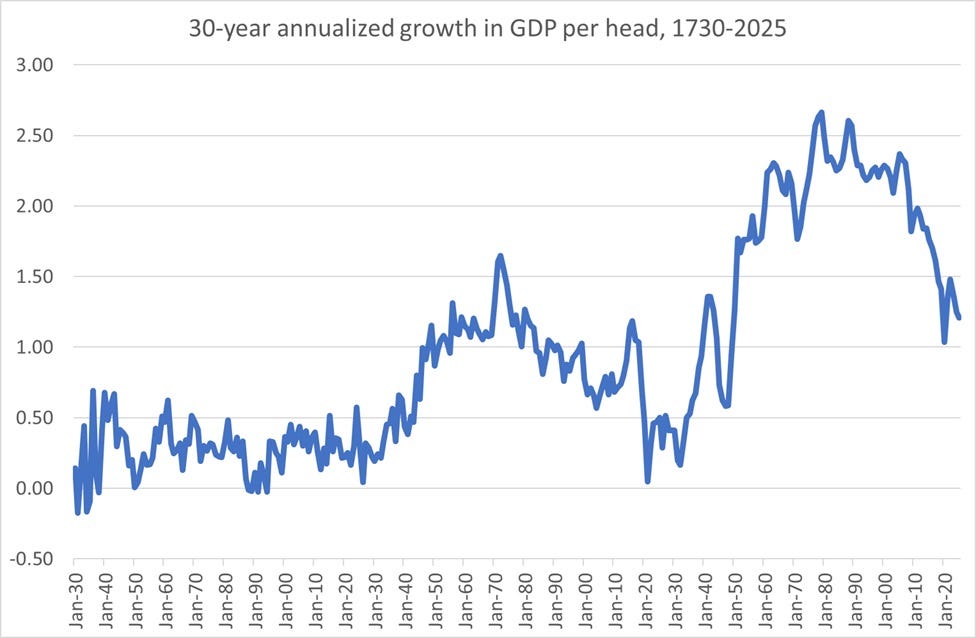
And even if we did get deregulation, it might not stimulate the economy. It’s very possible that our long-term stagnation is because capitalism has simply run out of dynamism, rather than because of meddling by those pesky kids.
The right cannot therefore articulate meaningful pro-capitalist policies. The limiting of its appeal to pensioners and bigots is no accident: it has no alternative.
The only sense in which the Tories or Reform are pro-capitalist is that they deflect attention from the failures of capitalism by shifting the blame for our economic problems onto migrants or benefit recipients - but then the same could be said of Labour.
Which poses the question: what, then, might a reasonable party of capitalists look like? It would be most odd not to have one, given that almost our entire political spectrum is pro-capitalist.
There’s room for a quite progressive party. It would want us to rejoin the EU, prioritizing the interests of exporters over the obsession of a few cranks. It would want a liberal immigration policy not because immigrants cut wages (they don’t) but because they can fill labour market shortages. It would want a simpler tax system, especially one that’s easier for the self-employed and which removes the high tax rates for parents earning just over £100,000. It would want to tax land rather than incomes. It would support universities as providers of technology, skilled workers and good jobs around the country. It would foster consumer advice and advocacy groups to ensure that good value financial products, phone and broadband contracts win customers, thereby helping efficient companies. And it would intervene in energy markets to ensure that UK companies no longer pay the highest electricity prices in Europe, which would include big building of solar and wind generation.
A progressive pro-capitalist party is therefore easy to imagine. It isn’t very far from the LibDems, although they carry the obnoxious baggage of the 2010-15 government.
I don’t know if such a programme could succeed. If it can’t, then the inference is obvious - that UK capitalism can now offer only reaction and stagnation.
* A wealth tax is not enough to make you anti-capitalist.
Discussion about this post
Ready for more?